
Affiliate disclosure: this site earns a commission from purchases made through links on our pages, including links to Amazon and other retailers, at no extra cost to you. Commissions do not affect our recommendations.
Last updated: 21 November 2026
Short answer
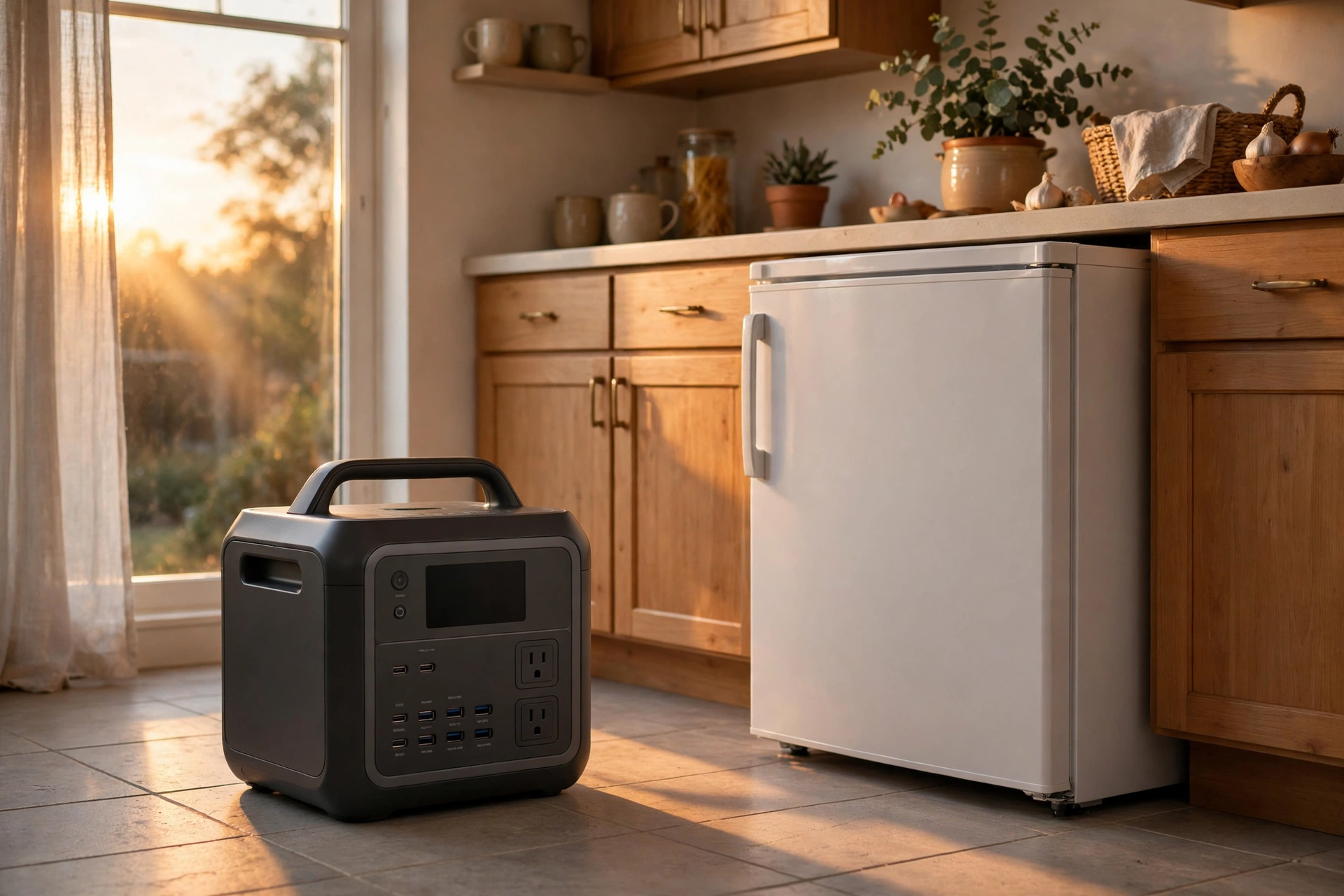
Yes. A solar generator can run a full-size fridge, but only if it is big enough in two ways, not one. The fridge needs about 1,200 Wh of energy per day, and its compressor draws a short surge of up to 2,350 W when it starts. A station with enough battery but too little surge capacity will trip the moment the compressor kicks in.
As a rough guide, a 1,536 Wh station runs a full-size fridge for about a day (around 26 hours). A 4,096 Wh station runs it for about three days (around 70 hours). A 768 Wh station runs it for about half a day, and may not start the compressor at all. The rest of this guide shows the numbers station by station, and which solar panel keeps the fridge going day after day.
How much power does a fridge use?
A full-size fridge does not draw its rated watts all day. The compressor cycles on and off, running roughly 8 hours out of 24. That 8-hour duty cycle is the standard planning assumption used by SolarGenAdvisor, OffGridAuthority and the US Energy.gov guidance they cite.
| Figure | Value | Source |
|---|---|---|
| Running watts | 150 W | SolarGenAdvisor appliance wattage chart (80–200 W range) |
| Hours per day (duty cycle) | 8 h | SolarGenAdvisor + OffGridAuthority, same assumption as Energy.gov |
| Energy per day | 150 W × 8 h = 1,200 Wh/day | Arithmetic from the two rows above |
| Compressor start surge (extra) | +1,200 to +2,200 W | SolarGenAdvisor appliance wattage chart |
| Peak draw at start-up | 150 + 2,200 = up to 2,350 W | Arithmetic, top of the surge range |
Check your own fridge’s label before you buy: an older or larger fridge can draw more than 150 W running, and a fridge in a hot room cycles more often. The 1,200 Wh/day figure is a planning number, not a measurement of your fridge.
A 12 V compressor fridge or cooler, the kind used for camping, is a much smaller load: about 45–60 W running and roughly 12 W on average over 24 hours, or about 288 Wh/day. If that is what you mean by “fridge”, a small station is enough; see our camping kits guide instead.
How long will a station run a fridge?
Runtime is a rough guide, calculated as station Wh × 0.85 ÷ 1,200 Wh/day (the 0.85 factor is a planning allowance for inverter and conversion losses, from SolarGenAdvisor’s wattage chart). It assumes the fridge is the only load. Real runtimes vary with room temperature, how often the door opens, and the age of the fridge.
| Station | Battery | AC output / surge | Fridge runtime (rough guide) | Compressor start |
|---|---|---|---|---|
| BLUETTI AC70 | 768 Wh | 1,000 W / 2,000 W | About 13 hours | Risky, see below |
| BLUETTI Elite 100 V2 | 1,024 Wh | 1,800 W / 3,600 W | About 17 hours | Passes |
| EcoFlow DELTA 3 (original) | 1,024 Wh | 1,800 W / 3,000 W | About 17 hours | Passes |
| BLUETTI Elite 100 mini | 1,004.8 Wh | 700 W / 1,050 W | About 17 hours | Risky, see below |
| EBL EB1000 | 999 Wh | 1,000 W / 2,000 W | About 17 hours | Risky, see below |
| EcoFlow DELTA 3 1500 | 1,536 Wh | 1,800 W / 3,600 W | About 26 hours (1.1 days) | Passes |
| EcoFlow DELTA 2 Max | 2,048 Wh | 2,400 W / 4,800 W | About 35 hours (1.5 days) | Passes |
| EcoFlow DELTA 3 Max Plus | 2,048 Wh | 3,000 W / 3,000 W | About 35 hours (1.5 days) | Passes |
| BLUETTI AC200L | 2,048 Wh | 2,400 W / 3,600 W | About 35 hours (1.5 days) | Passes |
| BLUETTI Elite 300 | 3,014.4 Wh | 2,400 W / 2,400 W | About 51 hours (2.1 days) | Passes, but tight |
| EcoFlow DELTA Pro 3 | 4,096 Wh | 4,000 W / 4,000 W | About 70 hours (2.9 days) | Passes |
Station specifications are from our verified Solar Match dataset (19 stations, checked against manufacturer pages). Full reviews: EcoFlow DELTA 3 1500, BLUETTI AC70, BLUETTI AC200L, EcoFlow DELTA Pro 3, BLUETTI Elite 300.
The practical minimum is about 1,500 Wh, the DELTA 3 1500 class, for a full day of fridge. Anything smaller is a half-day stopgap, not a day of backup.
What does NOT work: the compressor surge
Running watts are not the hard part. At 150 W running, every station in our list can power a fridge. The hard part is the start-up surge: up to 2,350 W for a moment when the compressor starts.
- BLUETTI Elite 100 mini (surge 1,050 W): cannot reliably start a full-size fridge compressor. The fridge may never start, or the station may shut down on overload. Do not buy this station for a full-size fridge.
- BLUETTI AC70 and EBL EB1000 (surge 2,000 W each): borderline. A fridge at the low end of the surge range (1,350 W peak) starts fine; a hard-starting compressor at the top of the range (2,350 W peak) exceeds the station’s surge rating and it will trip. If you already own one of these, test it with your fridge before you depend on it, and keep the fridge as the only load when the compressor starts.
- BLUETTI Elite 300 (surge 2,400 W): passes, but by only 50 W against a top-of-range start. It works, but there is almost no margin.
- DELTA 3 1500, DELTA 3, Elite 100 V2, DELTA 2 Max, DELTA 3 Max Plus, AC200L, DELTA Pro 3: surge ratings of 3,000 W or more, comfortably above the 2,350 W worst case.
If your fridge is old, large, or in a hot room, assume the top of the surge range. If in doubt, use our sizing calculator and enter the fridge with its surge, or check the combination in Solar Match.
What solar panel keeps the fridge running?
A fridge uses 1,200 Wh/day, so the panels must generate at least that much every day to keep it going indefinitely. Daily solar generation is a rough guide: panel watts × 4.0 peak sun hours × 0.85.
| Pairing | Daily solar (rough guide) | Covers 1,200 Wh/day? | Verified |
|---|---|---|---|
| EcoFlow DELTA 3 1500 + EcoFlow 400W Portable (original) | 400 × 4.0 × 0.85 = 1,360 Wh/day | Yes | Passes all Solar Match checks |
| EcoFlow DELTA 2 Max + EcoFlow 400W Portable (original) | 1,360 Wh/day | Yes | Passes all Solar Match checks |
| EcoFlow DELTA 3 1500 + 2× EcoFlow 160W Portable in series | 320 × 4.0 × 0.85 = 1,088 Wh/day | Almost, 112 Wh/day short | Passes all Solar Match checks |
| EBL EB1000 + any panel (max 150 W solar input) | At most 150 × 4.0 × 0.85 = 510 Wh/day | No, less than half a day’s fridge use | Panel limit is the station’s, not the panel’s |
Recharge time, as a rough guide, is station Wh ÷ (panel W × 4.0 × 0.85). The DELTA 3 1500 (1,536 Wh) with the 400 W panel recharges from empty in about 1.1 days of sun; the DELTA 2 Max (2,048 Wh) with the same panel takes about 1.5 days. Check any other station-and-panel combination in Solar Match before you buy, voltage, current and connector must all fit, not just watts.
Three pairings we checked that FAIL and must not be used on the DELTA 3 1500: the EcoFlow 400W Lightweight panel, the Renogy 400W Solar Blanket and the BLUETTI PV350D all fail the station’s 15 A solar current check (their short-circuit current × 1.25 safety margin is 15.25 A, 16.38 A and 17.25 A). Same watts, wrong current. This is exactly what Solar Match checks for.
Safety: running a fridge indoors on a battery station
A battery power station makes no exhaust, no carbon monoxide and no fumes, so it is the only kind of generator that is safe to run indoors, in a dry, ventilated room, with its vents clear. That is why a fridge, which lives in the kitchen, pairs with a battery station and not with a fuel generator: every gas, propane or dual-fuel generator must stay outside, at least 20 feet from the house, never in a home, garage, basement or shed, the US Consumer Product Safety Commission rule cited in SolarGenAdvisor’s indoor-safety guide.
Two practical notes: keep the fridge door closed as much as possible during an outage, US guidance (Ready.gov) says a closed refrigerator keeps food cold for about four hours without power, and do not run the fridge on an extension lead rated below the compressor’s surge. If the food has been above fridge temperature for hours, throw it out; a power station cannot make unsafe food safe again.
Which station to pick for a fridge
Buy on the surge rating first, then on the battery size. A station that cannot start the compressor is useless for a fridge, however big its battery is.
- Practical minimum, one day: about 1,500 Wh, the EcoFlow DELTA 3 1500 class, paired with the 400 W panel. It runs a full-size fridge for about 26 hours and its 3,600 W surge clears the 2,350 W worst case with room to spare. The 400 W panel generates about 1,360 Wh a day in good sun, enough to keep the fridge going day after day.
- Multi-day outage: 2,048 Wh or more, the DELTA 3 Max Plus, DELTA 2 Max or AC200L class. About 35 hours of fridge on battery alone, and a 400 W panel keeps it topped up in good sun.
- Do not buy for a full-size fridge: the BLUETTI Elite 100 mini (surge 1,050 W), the BLUETTI AC70 and the EBL EB1000 (surge 2,000 W each). The Mini cannot reliably start the compressor at all, and the other two are borderline against a hard-starting compressor. A half-day stopgap is not a day of backup.
Our pick for most homes is the DELTA 3 1500 with the 400 W panel: the smallest combination in this guide that passes the surge check comfortably, covers a full day, and generates enough solar to keep going. If your outage typically lasts two days or more, step up to a 2,048 Wh station rather than buying a bigger panel, the battery is the limit, not the panel. And test the combination with your own fridge before you depend on it: run the fridge on the station for a few hours, with the fridge as the only load, and confirm the compressor starts and the station does not trip.
How we checked
All station specifications (battery Wh, AC output, surge, solar input, voltage range, current limit) come from our Solar Match dataset of 19 stations and 19 panels, verified against manufacturer pages and manuals. Appliance watts come from the SolarGenAdvisor appliance wattage chart (running watts, starting watts, runtime) and the OffGridAuthority reference table; the 8-hour fridge duty cycle is the assumption both sources use, the same one Energy.gov uses. Every runtime and recharge figure is arithmetic labelled “rough guide”, a planning estimate, not a measurement. We have not physically tested these stations with a fridge. Our full method, including the ten compatibility checks, is on our Methodology page. No prices are listed: prices change often, and we do not publish a price we have not verified as current. Weights are not listed: our catalogue does not publish verified weights.
Related guides
- Can a solar generator run a freezer?, same compressor problem, smaller daily load
- Can a solar generator run Starlink?, 2,160 Wh/day, a bigger solar job than a fridge
- Can a solar generator run a CPAP machine?, 448 Wh a night, a small station is enough
- Best solar generator kits for home backup, 4 verified station-and-panel kits for outages
- What size do I need? sizing calculator, work out your own loads
- Compare stations side by side, battery, output and solar input for all 19 stations