
Last updated: 21 November 2026
Affiliate disclosure: this site earns a commission from purchases made through links on our pages, including links to Amazon and other retailers, at no extra cost to you. Commissions do not affect our recommendations.
Why home backup needs its own list
A solar generator kit for home backup is not the same as a kit for camping. At a campsite, weight and packed size decide almost everything. At home, the station sits in one place and nobody carries it, what matters is how much energy it holds, how many appliances it can run at once, and how fast the panels can refill it while the grid is down.
That changes what matters. Capacity still matters, but for a different reason: a home backup kit has to keep a fridge cold, lights on, phones charged, and a wifi router running, for a full day or longer, with no wall socket to fall back on. AC output matters more too: a fridge, a microwave, and a coffee maker together draw far more than camping loads. And solar input matters most of all during a multi-day outage, because the panels are the only charger you have, a kit with too little panel power runs down over the outage no matter how big its battery is.
This guide picks 4 kits from our verified catalogue, from a 2,048 Wh setup for essential loads to a 4,096 Wh setup for whole-home backup during extended outages. Every pairing below was already checked in our main guide, Best Solar Generator Kits 2026: the panel’s voltage (Voc) and current (Isc) fall inside the station’s solar limits, the total panel watts sit at or below the station’s maximum solar input, and the connector matches or a named adapter cable exists. No prices are listed, prices change often, so check the current price before buying.
How to choose a home backup kit
Capacity (Wh): how much energy per outage day
Watt-hours (Wh) tell you how much energy the station can store. To size a home backup kit, add up the watt-hours your essential devices use in a day and compare that total with the station’s capacity. As a rough guide: a full-size fridge can use roughly 1,000–2,000 Wh per day, a laptop uses roughly 40–80 Wh per charge, and lights, a wifi router, and phone chargers use far less than a fridge. The fridge is almost always the biggest load in a home backup plan, size the station for the fridge first, then add the rest.
For a one-day outage, a useful rule is to size the station for one full day of your essential loads, and size the panels to refill most of that in one day of sun. If the panels cannot keep up, the station runs down over the outage no matter how big it is. For a multi-day outage, the panels matter more than the battery: the station only needs to hold a day’s energy if the sun refills it every day.
AC output (W): what you can run at once
The AC output in watts tells you what the station can power at the same time. A 3,000 W station can run most household appliances one at a time, a fridge, a microwave, or a coffee maker, but not several large ones together. A 3,600–4,000 W station can run several large appliances at once. Check the running watts of your biggest device, and remember that some motors and compressors draw a short surge at start-up: a fridge compressor, for example, draws more power for a moment when it starts than when it runs. The devices that usually decide the AC output for home backup are the fridge, a microwave or kettle, and any motor-driven appliance such as a sump pump, not phones, lights, and laptops.
Solar input (W): how fast the sun refills it during an outage
The maximum solar input tells you the most panel power the station can accept. A station rated for 1,000 W of solar input will not charge faster if you connect 1,500 W of panels, the extra power is simply not used. For home backup, the panel watts matter more than the battery size during a long outage, because the panels are the only charger you have while the grid is down. A good home backup pairing uses a useful share of the station’s solar maximum, and a station with a high solar maximum leaves room to add panels later.
As a rough guide only, divide the station’s Wh by the panels’ real-world watts, panels typically deliver around 70–80% of their rated watts in good sun, and often less in poor conditions, to get an approximate number of sun hours for a full recharge. This is an estimate, not a guaranteed figure. A 2,048 Wh station with a 400 W panel, for example, needs roughly 6–7 hours of good sun to recharge from empty. A 3,584 Wh station with the same 400 W of panels needs roughly 11–13 hours, more than a day of sun, so plan on adding panels if you want it to recharge in a single day.
Panel Voc and Isc vs station limits
Two panel numbers matter most for compatibility:
- Voc (open-circuit voltage) must fall inside the station’s solar voltage range. A panel with a Voc above the station’s maximum can damage the charging circuit. A panel with a Voc below the minimum will not charge at all.
- Isc (short-circuit current) must be at or below the station’s maximum solar current. A panel with a higher Isc than the station allows is not a safe match.
Connector
The panel and the station must connect, directly or with a named adapter cable. Common connectors are MC4 (the solar standard), XT60 and XT60i (EcoFlow), and DC8020 (Jackery). Check the connector before you buy, if no adapter exists for your combination, the panel cannot be used with that station. For the full background, see our guides on Voc vs Vmp, the compatibility checklist, EcoFlow XT60 vs XT60i, and BLUETTI solar input.
Region and voltage
Some stations are sold in different versions for different regions, and a few have different solar current limits by region. The EcoFlow DELTA 3 Max Plus, for example, allows 18 A of solar current per the US manual; the EU current rating is not confirmed on EcoFlow’s EU page. Check which version you are buying and use that version’s limits.
The home backup kits at a glance
| Kit / pairing | Station | Panels | Total panel watts | Station max solar | Best for |
|---|---|---|---|---|---|
| EcoFlow DELTA 3 Max Plus + 400W Portable | 2,048 Wh / 3,000 W AC | 1× 400 W | 400 W | 1,000 W | Essential loads, one large appliance at a time |
| Jackery HomePower 3000 Solar Generator (official kit) | 3,072 Wh / 3,600 W AC | 2× SolarSaga 200W | 400 W | 1,000 W | Fridge + lights + laptops during an outage |
| Jackery HomePower 3600 Plus + 2× SolarSaga 200W | 3,584 Wh / 3,600 W AC | 2× SolarSaga 200W | 400 W | 1,000 W | Larger capacity, room to add panels |
| EcoFlow DELTA Pro 3 + 2× 400W Portable | 4,096 Wh / 4,000 W AC | 2× 400 W | 800 W | 2,600 W | Whole-home backup, extended outages |
Mid-size home backup (2,000–3,000 Wh)
EcoFlow DELTA 3 Max Plus + EcoFlow 400W Portable (original)
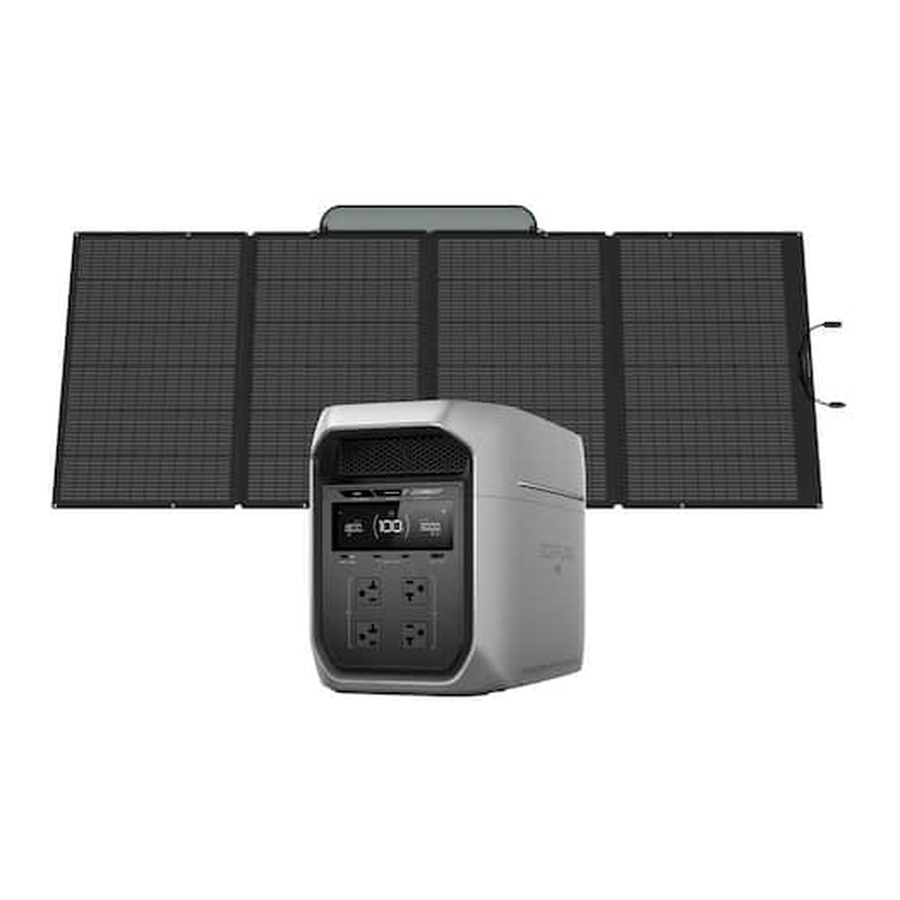
The DELTA 3 Max Plus holds 2,048 Wh and delivers 3,000 W of AC output, enough for most household appliances one at a time. It accepts up to 1,000 W of solar input at 11–60 V, with a maximum solar current of 18 A per the US manual (the EU current rating is not confirmed on EcoFlow’s EU page), through two XT60i ports. The original 400W Portable panel has a Voc of 48 V and an Isc of 11 A, which fits the station’s limit, and its 400 W is well within the 1,000 W maximum. The panel uses an MC4 connector, so it connects to the XT60i ports with an MC4-to-XT60i adapter cable, see our guide on MC4 to XT60i vs XT60.
This is the entry point for home backup in this guide: enough capacity for a fridge and the essentials for about a day, and enough AC output for a large appliance at a time. A single 400 W panel refills it in roughly 6–7 hours of good sun, so it can keep up with a day’s essential loads if the sun cooperates. This pairing also leaves room to grow: a second 400 W panel can be added on the second port, since the station accepts one panel per port, that would roughly halve the recharge time.
Key numbers: station 2,048 Wh / 3,000 W AC; panel 400 W, Voc 48 V, Isc 11 A; station solar limits 11–60 V / 18 A per the US manual / 1,000 W max.
Large home backup (3,000 Wh and up)
Jackery HomePower 3000 Solar Generator: official kit
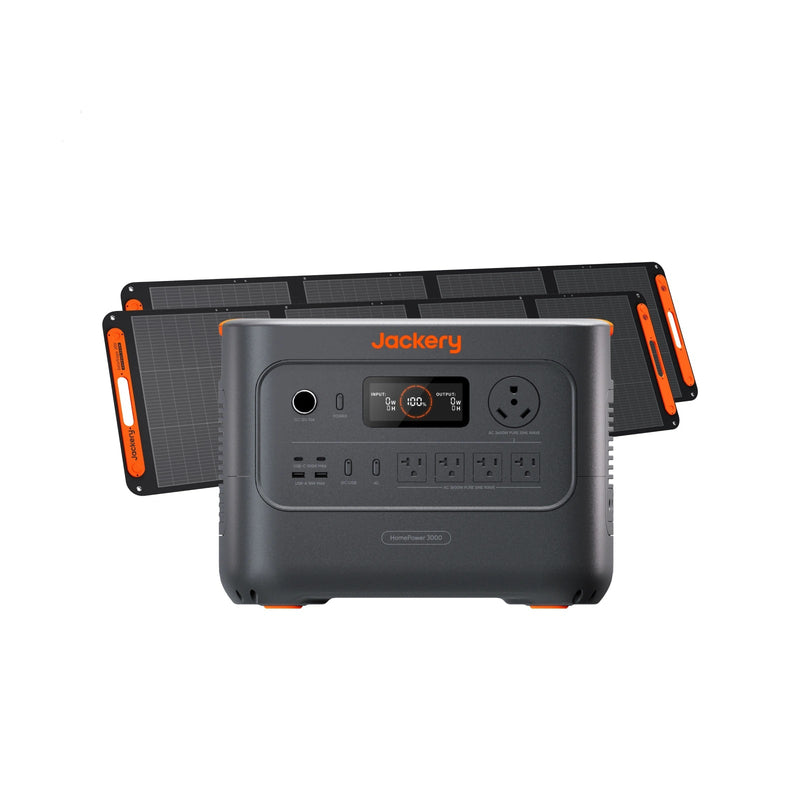
The HomePower 3000 Solar Generator is an official kit from Jackery: the station plus two SolarSaga 200W panels, sold together. The station holds 3,072 Wh and delivers 3,600 W of AC output. It accepts up to 1,000 W of solar input at 16–60 V, up to 12 A per port, through two DC8020 ports. Each SolarSaga 200W panel has a Voc of 24.8 V and an Isc of 11.2 A, fitting the station’s limits, and the two panels together give 400 W. The SolarSaga 200W Isc figure of 11.2 A is tool-data-only: it comes from our Solar Match tool data, not from a manufacturer datasheet we could re-check. Confirm the Isc on Jackery’s current datasheet before buying.
This is the only named, manufacturer-sold kit in this guide, which removes the compatibility question entirely: Jackery chose the pairing, so there is nothing to verify between panel and station. With 3,072 Wh and 3,600 W of AC output, this kit covers a fridge, lights, laptops, a wifi router, and small appliances during an outage, and can run several of them at once. One honest limit: 400 W of panels against a 3,072 Wh battery means a full recharge from empty takes roughly 10–11 hours of good sun. For a one-day outage that is fine, the battery carries the day. For a multi-day outage, plan on adding panel power: the station accepts up to 1,000 W of solar, so there is room to grow.
Key numbers: station 3,072 Wh / 3,600 W AC; panels 2× 200 W, Voc 24.8 V, Isc 11.2 A each*; station solar limits 16–60 V / 12 A per port / 1,000 W max.
* The SolarSaga 200W Isc figure of 11.2 A is tool-data-only: it comes from our Solar Match tool data, not from a manufacturer datasheet we could re-check. The panel’s Voc of 24.8 V is published on the catalogue card for the Jackery HomePower 3000 kit, which uses the same two SolarSaga 200W panels. Confirm the Isc on Jackery’s current datasheet before buying.
Jackery HomePower 3600 Plus + 2× SolarSaga 200W
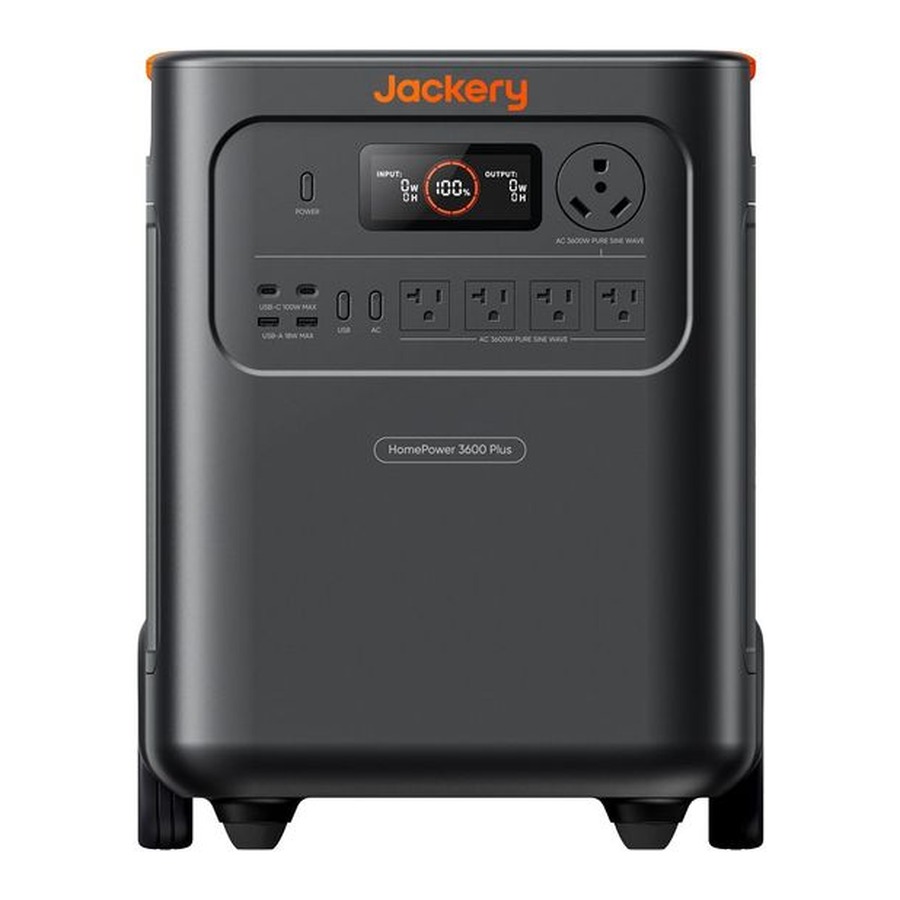
The HomePower 3600 Plus is the larger sibling of the HomePower 3000 kit: 3,584 Wh of capacity and 3,600 W of AC output. It accepts up to 1,000 W of solar input at 16–60 V, up to 12 A per port, through two DC8020 ports. Two SolarSaga 200W panels give 400 W, with each panel’s Voc of 24.8 V and Isc of 11.2 A fitting the station’s limits. The SolarSaga 200W Isc figure of 11.2 A is tool-data-only: it comes from our Solar Match tool data, not from a manufacturer datasheet we could re-check. Confirm the Isc on Jackery’s current datasheet before buying.
Compared with the HomePower 3000 kit, this pairing offers about 500 Wh more capacity in a similar form, roughly half a day more of fridge runtime, or more headroom for extra loads. The same honest limit applies: 400 W of panels is modest against a 3,584 Wh battery, so a full recharge from empty takes roughly 11–13 hours of good sun. The 1,000 W solar maximum leaves room to add more panel power later, for example by using higher-wattage panels that still fit the 16–60 V and 12 A per-port limits. Check the combined numbers first, and verify any new combination with the Solar Match tool before connecting it.
Key numbers: station 3,584 Wh / 3,600 W AC; panels 2× 200 W, Voc 24.8 V, Isc 11.2 A each*; station solar limits 16–60 V / 12 A per port / 1,000 W max.
* The SolarSaga 200W Isc figure of 11.2 A is tool-data-only: it comes from our Solar Match tool data, not from a manufacturer datasheet we could re-check. The panel’s Voc of 24.8 V is published on the catalogue card for the Jackery HomePower 3000 kit, which uses the same two SolarSaga 200W panels. Confirm the Isc on Jackery’s current datasheet before buying.
EcoFlow DELTA Pro 3 + 2× EcoFlow 400W Portable (original)

The DELTA Pro 3 is the largest station in this guide: 4,096 Wh of capacity and 4,000 W of AC output. It accepts up to 2,600 W of solar input through two ports: a high-voltage port (30–150 V, up to 15 A, XT60) and a low-voltage port (11–60 V, up to 20 A, XT60i). Two original 400W Portable panels give 800 W in total, one per port, each connected with an MC4-to-XT60 adapter cable on the high-voltage port (or MC4-to-XT60i on the low-voltage port). Each panel’s Voc of 48 V and Isc of 11 A fits either port’s limits.
At 800 W against a 2,600 W maximum, this pairing uses less than a third of the station’s solar capacity, and it still recharges the 4,096 Wh battery in roughly 6–7 hours of good sun. That is deliberate: two panels are a practical starting set, and the station has room for much more panel power later. For a station this size, plan on adding panels if you want it to recharge from sun in a single day during a long outage, or if you want to run heavy loads and recharge at the same time. This is the whole-home pick in this guide: the most capacity, the most AC output, and by far the most room to grow.
Key numbers: station 4,096 Wh / 4,000 W AC; panels 2× 400 W, Voc 48 V, Isc 11 A each; station solar limits HV 30–150 V / 15 A, LV 11–60 V / 20 A / 2,600 W max.
What to check before you buy
- Panel Voc against the station’s voltage range. The panel’s Voc must sit inside the station’s solar voltage range. Above the maximum risks damage; below the minimum means no charging. Our compatibility guide walks through this step by step.
- Panel Isc against the station’s current limit. The panel’s Isc must be at or below the station’s maximum solar current. Check the limit for your region, some stations differ between US and EU versions.
- Total panel watts against the station’s maximum solar input. Adding panels beyond the maximum does not charge the station faster. Read our guide on over-paneling to understand what happens when panel watts exceed the limit.
- Connector and adapter cables. Confirm the panel’s connector matches the station, or that a named adapter exists, for example, an MC4-to-XT60 or MC4-to-XT60i cable for EcoFlow stations, or a DC8020 cable for Jackery. A panel with the wrong connector and no available adapter cannot be used.
- Two panels: series or parallel. Connecting two panels changes the voltage and current the station sees. Series adds voltage; parallel adds current. Either can push the combination out of the station’s limits even when each panel alone is fine. See series vs parallel.
- Never backfeed your house wiring. Never plug a portable power station into a wall outlet to power your home’s circuits. That is called backfeeding: it can energise the grid, endanger utility workers, and damage the station. Power individual appliances with extension cords from the station instead. If you want the station to power fixed circuits, have a licensed electrician install a transfer switch.
- Safe to use indoors, with vents clear. Unlike a petrol generator, a solar generator produces no exhaust fumes, so it can be used indoors. Keep its air vents clear, keep it dry, and do not cover it while it runs.
- Panel placement during an outage. Panels rarely reach their rated watts. Clouds, shade, angle, and heat all reduce output, and at home, roofs, walls, and trees shade panels more often than in an open field. Place the panels in full sun, angle them toward the sun, and move them during the day if you can. If charging seems slow, see our guide on why solar charging is slow and the solar charging optimisation guide before assuming something is broken.
FAQ
How long will a solar generator run my fridge?
It depends on the fridge and the station. A full-size fridge uses roughly 1,000–2,000 Wh per day, so a 2,048 Wh station covers about a day of fridge-only use, a 3,072 Wh station covers about a day and a half, and a 4,096 Wh station covers about two days, before counting lights, laptops, and other loads. Check your fridge’s rated watts and daily consumption on its label or manual, and remember the compressor draws a short surge at start-up. During an outage, the panels refill the station each day, so the real limit is whether the panels can replace what the fridge uses in a day.
What size solar generator do I need for home backup?
Add up the watt-hours your essential devices use in a day, the fridge first, then lights, router, phones, and laptops, and pick a station with at least that much capacity. For a fridge plus the essentials for one day, 2,048 Wh is a starting point; for a fridge plus more appliances, or for more than a day without sun, 3,000–4,096 Wh is safer. Then check the AC output: it must cover the running watts of everything you want on at the same time, plus the start-up surge of motors and compressors.
Can a solar generator power my whole house?
It can power the appliances you plug into it, but not your home’s fixed wiring, never plug a station into a wall outlet to backfeed the house. A 4,000 W station such as the DELTA Pro 3 can run a fridge, lights, laptops, a wifi router, and several other appliances at once through extension cords. It cannot run a central air conditioner or an electric water heater, those draw far more than any portable station delivers. If you want backup for fixed circuits, ask a licensed electrician about a transfer switch.
Is it safe to use a solar generator indoors?
Yes. Unlike a petrol generator, a solar generator produces no exhaust fumes, so it can run inside the house. Keep its air vents clear, keep it dry, and do not cover it while it runs. The panels, of course, must stay outside in the sun, run the panel cable through a window or door to the station inside.
Can I plug the station into a wall outlet to power my house?
No. That is backfeeding: it can energise the grid, endanger utility workers, and damage the station. Power individual appliances with extension cords from the station. For fixed circuits, a licensed electrician must install a transfer switch.
How many solar panels do I need to recharge during an outage?
Enough panel watts to replace a day’s use in a day of sun. As a rough guide only, divide the station’s Wh by the panels’ real-world watts, panels typically deliver around 70–80% of their rated watts in good sun, and often less in poor conditions, to get an approximate number of sun hours for a full recharge. A 2,048 Wh station with 400 W of panels needs roughly 6–7 hours of good sun; a 3,584 Wh station with the same 400 W needs roughly 11–13 hours. This is an estimate, not a guaranteed figure.
Can I add a second panel or more capacity later?
Usually yes, if the station has a second solar port or the combined panels stay within its voltage, current, and watt limits. The DELTA 3 Max Plus and DELTA Pro 3 in this guide both have a second solar port for exactly that. Check series vs parallel wiring first, and verify the combination with the compatibility checklist.
Can I use a panel from a different brand than my station?
Yes, if the numbers match. Brand does not matter; voltage, current, watts, and connector do. The pairings in this guide are all same-brand except where the numbers were verified, see our main kits guide for a cross-brand example (BLUETTI AC200L with an EcoFlow 400W panel).
What happens if the panel’s Voc is higher than the station’s maximum?
Do not connect it. A Voc above the station’s maximum solar voltage can damage the charging circuit. Choose a panel with a lower Voc or a station with a higher voltage range.
Do I need an adapter cable?
It depends on the pairing. Some panels and stations share a connector (MC4 to MC4, for example). Others need a named adapter, such as MC4-to-XT60 or MC4-to-XT60i for EcoFlow stations or DC8020 for Jackery. Check the connector on both sides before ordering.
Which home backup kit to pick
Pick by what must stay on during an outage. For essential loads one large appliance at a time, the EcoFlow DELTA 3 Max Plus kit covers a fridge, lights and laptops with 2,048 Wh and 3,000 W of output. For a fridge plus lights and laptops through a day, the Jackery HomePower 3000 official kit gives 3,072 Wh and 3,600 W with two panels included. For a larger household, the Jackery HomePower 3600 Plus adds 512 Wh to the same 3,600 W output. For several large appliances at once over more than a day, the EcoFlow DELTA Pro 3 is the only kit here with both 4,096 Wh and 4,000 W of output, plus 2,600 W of solar input for a faster refill.
Then check the refill rule, because during a long outage the panels are the only charger you have. Divide the station’s Wh by the panels’ real-world watts, about 70 to 80 percent of rated watts in good sun. A single 400 W panel refills a 2,048 Wh station in about six to seven hours of good sun, but it takes far longer on a 4,096 Wh station, so the bigger kits need more panel watts to do the job again the next day. Plan the panels for the second day, not just the first night.
Safety notes for home backup
Never connect a station’s AC output to household wiring or the grid. That kind of connection, known as backfeeding, can injure line workers and damage the station, so use the station’s own sockets and extension leads instead. Check Voc, Isc and watts for every panel before you connect it, using the limits in each kit section above, and check which regional version you are buying, because solar current limits can differ between the US and EU versions. Keep the station indoors in a dry, ventilated place with its vents clear, and do not cover it while it charges. Add up the running watts before you switch things on, and remember that a fridge compressor draws a short surge when it starts. Do not rely on a portable station for medical or life-support equipment, and if any battery, cable or panel is damaged, swollen or unusually hot, stop using it and check the manual.
How we verify specs
All specifications in this guide were checked against manufacturer pages and manuals, and against the verified station and panel data in our Solar Match tool, on 2026-11-16. The one exception is the SolarSaga 200W Isc figure of 11.2 A, which is tool-data-only, see the flags in the HomePower 3000 and HomePower 3600 Plus sections. The 4 pairings in this guide are the home backup picks from our main kits guide, Best Solar Generator Kits 2026, where each pairing was verified the same way. We record the station’s capacity (Wh), AC output (W), maximum solar input (W), solar voltage range (V), maximum solar current (A), and connector, and the panel’s rated watts, Voc, Isc, and connector. A pairing is included only when the panel’s Voc falls inside the station’s voltage range, the panel’s Isc is at or below the station’s current limit, the total panel watts are at or below the station’s maximum solar input, and the connector matches or a named adapter cable is used. Where a specification was not published, we say so and do not guess. No prices are listed in this guide: prices change often, and we do not publish a price we have not verified as current. Weights are not listed either: the /product/ catalogue does not publish verified weights, and we do not publish a weight we have not verified against the current manufacturer datasheet.
Closing
A good home backup kit is a matched pair that keeps the fridge cold and the essentials running through an outage, and refills from the sun fast enough to do it again the next day. Start with what you need to power and how much energy that takes in a day, then pick a station with enough capacity and AC output, and panels that fit its voltage, current, and watt limits and can refill a useful share of the battery in one day of sun. The kits in this guide are a starting point, check any station and panel combination with our Solar Match tool and browse the full range in our product catalogue. For the full list of 9 verified kits, see Best Solar Generator Kits 2026. For more background, see the portable energy guide hub.