
Publication history: Originally published 17 May 2026. Substantially reviewed and updated 23 August 2026.
Module role: choose an array configuration after panel and station limits are known. This page does not replace the complete T9 Compatibility Method.
The calculations below are documentation-based. They are not physical tests.
Configuration Equations
For matched panels, NS panels per series string and NP parallel strings:
- Vocarray = Vocpanel × NS
- Vmparray ≈ Vmppanel × NS
- Imparray ≈ Imppanel × NP
- Iscarray ≈ Iscpanel × NP
- Parray = Ppanel × NS × NP
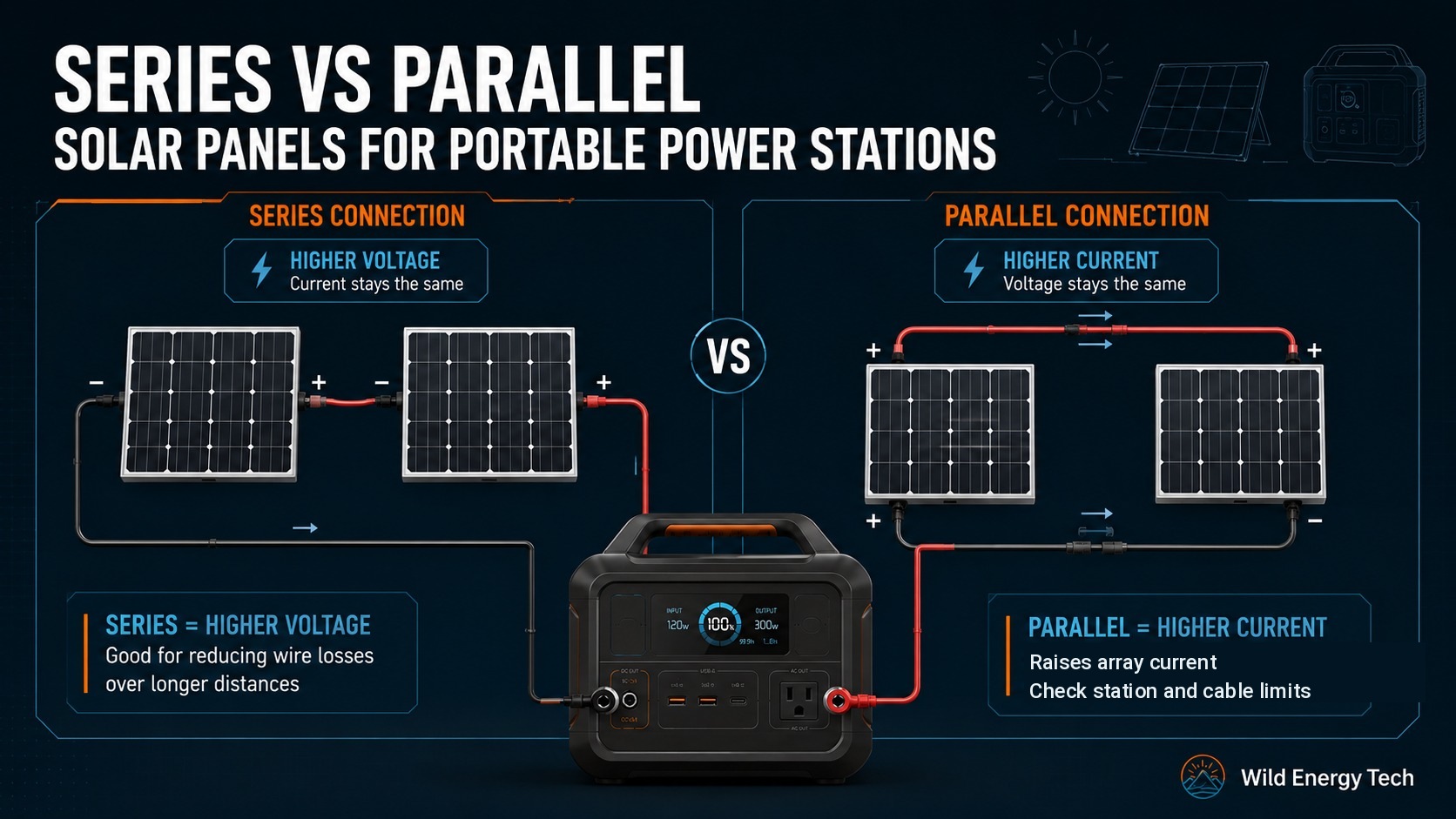
Series raises string voltage. Parallel raises array current. Power increases with the total number of panels. These arithmetic rules do not determine whether the station permits the result.
The Configuration Decision Matrix
| Starting constraint | What series changes | What parallel changes | Decision |
|---|---|---|---|
| Little voltage headroom; current headroom available | Raises Voc and may breach the hard ceiling | Retains string voltage but raises current | Parallel may solve voltage placement only if all current/Isc, cable and manufacturer limits pass |
| Voltage headroom available; strict current limit | Raises voltage while retaining one string’s current | Raises current and may exceed port/connector limits | Series may be electrically preferable only after cold Voc and Vmp checks |
| Vmp below controller operating range | Can raise operating voltage | Does not materially raise Vmp | Series may help startup but must remain below cold-Voc maximum |
| Cold Voc already near maximum | Unsafe margin becomes smaller | Does not multiply string voltage | Do not add series panels; assess an allowed parallel design instead |
| Array current already near limit | Current remains near one panel/string | Current multiplies | Do not add parallel strings without documented headroom |
Worked Configuration: EcoFlow Panel and DELTA 2
Published inputs used: DELTA 2 manual solar input 11–60 V, 15 A, 500 W. NextGen 220 W panel manual: Voc 21.5 V, Vmp 18.4 V, Isc 12.4 A, Imp 11.9 A, nominal βVoc −0.25%/°C with ±0.03%/°C tolerance. T9 calculations use −10°C as an illustrative minimum. The displayed cold values are nominal; use the conservative −0.28%/°C end for a hard-limit decision near the ceiling.
One panel
Cold solar panel Voc ≈ 23.38 V, Vmp 18.4 V, Imp 11.9 A, 220 W. The electrical values sit inside the cited station figures.
Two panels in series: 2S1P
- Cold Voc ≈ 46.76 V
- Vmp ≈ 36.8 V
- Imp ≈ 11.9 A; Isc ≈ 12.4 A
- Power = 440 W
This arrangement remains inside the cited voltage, current and power figures. Connector and manufacturer instructions still control.
Two panels in parallel: 1S2P
- Cold Voc ≈ 23.38 V
- Vmp ≈ 18.4 V
- Imp ≈ 23.8 A; Isc ≈ 24.8 A
- Power = 440 W
Voltage and power fit, but calculated panel current exceeds the published 15 A station maximum. The cited DELTA 2 section does not prove blanket approval of this higher-current array. Classification: manufacturer confirmation required; do not assume current clipping grants permission.
Three panels in series: 3S1P
STC Voc = 64.5 V, already above the 60 V maximum. Cold Voc would be higher. Classification: do not connect.
Cold Weather Sets the Series Ceiling
Use the actual panel coefficient:
Vocarray,cold = NS × Vocpanel × [1 + βVoc × (Tminimum cell − 25°C)]
The Victron installation manual explicitly requires designers to account for Voc and temperature coefficient when selecting series count. Do not size a string from Vmp or nominal voltage.
Parallel Current Changes More Than the Controller Reading
A station may draw less than the array’s available current, but branch connectors, conductors, fuses and terminations can still carry array current under applicable conditions. Check calculated Imp and Isc against every component and the manufacturer’s input rules. “The station only takes what it needs” is not a complete cable or protection assessment.
Mismatch and Partial Shade
Series current can be constrained by a weaker or shaded panel/string. Parallel strings can contribute different currents, but mismatched voltages and dissimilar panels complicate the operating point. Use matched panels and follow the manufacturer’s documented connection rules. PVEducation’s mismatch reference explains how non-uniform conditions affect array output; it does not create permission to exceed a station limit.
Configuration Record
| Check | Series result | Parallel result |
|---|---|---|
| NS / NP | _____ | _____ |
| Cold Voc | _____ V | _____ V |
| Vmp | _____ V | _____ V |
| Imp / Isc | _____ A | _____ A |
| Rated power | _____ W | _____ W |
| Controller and cable limits pass? | Yes / No / Unknown | Yes / No / Unknown |
| Manufacturer permits configuration? | Yes / No / Unknown | Yes / No / Unknown |
Stop Rules
- Cold string Voc can exceed the station maximum.
- Parallel Imp/Isc exceeds a documented port, controller, cable or connector rule.
- Vmp does not meet the documented operating requirement.
- Panels are materially mismatched and the manufacturer does not document the arrangement.
- Branch protection, connector ratings or polarity are unknown.