
Last updated: 21 November 2026
Affiliate disclosure: this site earns a commission from purchases made through links on our pages, including links to Amazon and other retailers, at no extra cost to you. Commissions do not affect our recommendations.
Why camping needs its own list
A solar generator kit for camping is not the same as a kit for home backup. At home, the station sits in one place and size barely matters. At a campsite, everything you bring has to be carried, set up, and packed away again, and the only way to recharge is the sun above the tent.
That changes what matters. Capacity still matters, but so does how fast the panel can refill the station during the day, because a camping kit is used and recharged in the same trip, often every day. A panel that is too small for the station means the battery drains faster than the sun can refill it. A station that is too big for the trip means carrying weight you never use.
This guide picks 5 kits from our verified catalogue, from a light 768 Wh setup for short trips to a 3,014 Wh base-camp setup for longer stays. Every pairing below was already checked in our main guide, Best Solar Generator Kits 2026: the panel’s voltage (Voc) and current (Isc) fall inside the station’s solar limits, the total panel watts sit at or below the station’s maximum solar input, and the connector matches or a named adapter cable exists. No prices are listed, prices change often, so check the current price before buying.
How to choose a camping kit
Capacity (Wh): how much energy per day
Watt-hours (Wh) tell you how much energy the station can store. To size a camping kit, add up the watt-hours your devices use in a day and compare that total with the station’s capacity. As a rough guide: a phone charger uses a few watt-hours per charge, a laptop uses roughly 40–80 Wh per charge, and a full-size fridge can use roughly 1,000–2,000 Wh per day. A small portable camping fridge uses less than a full-size home fridge, but check its rated watts and daily consumption before you rely on it, the number varies a lot between models.
For a weekend trip, a useful rule is to size the station for one full day of your loads, and size the panels to refill most of that in one day of sun. If the panels cannot keep up, the station runs down over the trip no matter how big it is.
AC output (W): what you can run at once
The AC output in watts tells you what the station can power at the same time. A 1,000 W station can run a laptop, lights, and a small fan together, but not a 1,500 W kettle. Check the running watts of your biggest device, and remember that some motors and compressors draw a short surge at start-up. For camping, the devices that usually decide the AC output are a portable fridge, a coffee maker, or a power tool, not phones and lights.
Solar input (W): how fast the sun refills it
The maximum solar input tells you the most panel power the station can accept. A station rated for 500 W of solar input will not charge faster if you connect 800 W of panels, the extra power is simply not used. For camping, the panel watts matter more than at home, because the panel is the only charger you have. A good camping pairing uses a large share of the station’s solar maximum with one or two panels, so a day of sun refills a useful part of the battery.
As a rough guide only, divide the station’s Wh by the panels’ real-world watts, panels typically deliver around 70–80% of their rated watts in good sun, and often less in poor conditions, to get an approximate number of sun hours for a full recharge. This is an estimate, not a guaranteed figure.
Panel type: rigid, portable, or blanket
Camping panels come in three shapes. Rigid panels are the most efficient per watt but the hardest to carry. Portable folding panels pack flat and set up fast, which suits short trips. Solar blankets fold up smallest of all and are the easiest to carry, but check their folded size and weight before you buy. The kits below use portable panels and one solar blanket, no rigid panels, because a rigid panel is rarely the right choice for a campsite.
Weight and size: check the published figures
Weight matters more for camping than for any other use, and it varies widely between stations of similar capacity. This guide does not list weights, because the weights published by manufacturers change between versions and we do not publish a figure we have not verified against the current datasheet. Before you buy, check the station’s published weight and dimensions on the manufacturer’s page, and compare them with what you are willing to carry.
Panel Voc and Isc vs station limits
Two panel numbers matter most for compatibility:
- Voc (open-circuit voltage) must fall inside the station’s solar voltage range. A panel with a Voc above the station’s maximum can damage the charging circuit. A panel with a Voc below the minimum will not charge at all.
- Isc (short-circuit current) must be at or below the station’s maximum solar current. A panel with a higher Isc than the station allows is not a safe match.
Connector
The panel and the station must connect, directly or with a named adapter cable. Common connectors are MC4 (the solar standard), XT60 and XT60i (EcoFlow), and DC8020 (Jackery). Check the connector before you buy, if no adapter exists for your combination, the panel cannot be used with that station. For the full background, see our guides on Voc vs Vmp, the compatibility checklist, EcoFlow XT60 vs XT60i, and BLUETTI solar input.
The camping kits at a glance
| Kit / pairing | Station | Panels | Total panel watts | Station max solar | Best for |
|---|---|---|---|---|---|
| BLUETTI AC70 + SP100L | 768 Wh / 1,000 W AC | 1× 100 W | 100 W | 500 W | Light trips, phones, laptops, lights |
| EcoFlow DELTA 3 1500 + 400W Lightweight | 1,536 Wh / 1,800 W AC | 1× 400 W | 400 W | 500 W | Weekend camping, small fridge |
| Jackery Explorer 2000 v2 + 2× SolarSaga 200W | 2,042 Wh / 2,200 W AC | 2× 200 W | 400 W | 400 W | Family camping, full solar use |
| BLUETTI AC200L + EcoFlow 400W Portable | 2,048 Wh / 2,400 W AC | 1× 400 W | 400 W | 1,200 W | Longer stays, room to add panels |
| BLUETTI Elite 300 + Renogy 400W Solar Blanket (G3) | 3,014.4 Wh / 2,400 W AC | 1× 400 W | 400 W | 1,200 W | Base camp, folding panel, large capacity |
Light trips (under 1,000 Wh)
BLUETTI AC70 + BLUETTI SP100L 100W

The AC70 is a compact station: 768 Wh of capacity, 1,000 W of AC output, and a maximum solar input of 500 W at 12–58 V and up to 10 A. The BLUETTI SP100L is a 100 W panel with a Voc of 24.62 V and an Isc of 5.13 A, both comfortably inside the AC70’s limits. The connector is not published for this panel, so check with the seller that the cable you need is included before ordering.
This is a light-use kit: phones, laptops, lights, a small fan, or a camera battery charger. At 100 W of panel, a full recharge from empty takes a long day of good sun, so this kit suits short trips and top-ups rather than daily off-grid living. Its strength for camping is its size: it is the smallest station in this guide, and the 100 W panel is easy to carry and set up. If your trip is one or two nights and your loads are small, this is the kit that asks the least of you to carry.
Key numbers: station 768 Wh / 1,000 W AC; panel 100 W, Voc 24.62 V, Isc 5.13 A; station solar limits 12–58 V / 10 A / 500 W max.
Weekend camping (1,000–2,000 Wh)
EcoFlow DELTA 3 1500 + EcoFlow 400W Lightweight

The DELTA 3 1500 holds 1,536 Wh and delivers 1,800 W of AC output. Its solar input is rated at 500 W maximum, 11–60 V, up to 15 A, through an XT60 connector. The 400W Lightweight panel has a Voc of 39.3 V and an Isc of 12.2 A, which fits the station’s range, and its 400 W sits just under the 500 W maximum, a good match that uses most of the station’s solar capacity with a single panel.
This pairing is a practical choice for camping and weekend trips, where the station also needs to run a small fridge or a power tool. A single 400 W panel keeps the setup simple: one panel to unfold, one cable to connect, and most of the station’s solar capacity in use. Note the model name carefully: the DELTA 3 1500 is 1,536 Wh. The original DELTA 3 is a different model at 1,024 Wh.
Key numbers: station 1,536 Wh / 1,800 W AC; panel 400 W, Voc 39.3 V, Isc 12.2 A; station solar limits 11–60 V / 15 A / 500 W max.
Jackery Explorer 2000 v2 + 2× SolarSaga 200W
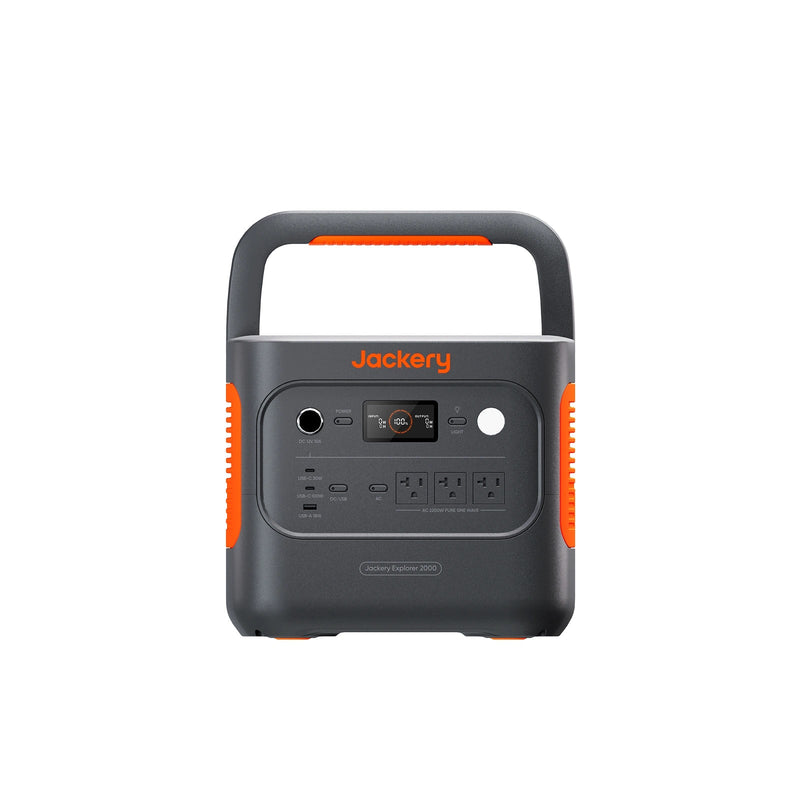
The Explorer 2000 v2 holds 2,042 Wh and delivers 2,200 W of AC output. Its solar input is rated at 400 W maximum, 16–60 V, up to 12 A per port, through two DC8020 ports. Two SolarSaga 200W panels give exactly 400 W, the station’s full solar maximum, with one panel per port. Each panel’s Voc of 24.8 V and Isc of 11.2 A fit the station’s limits. The SolarSaga 200W Isc figure of 11.2 A is tool-data-only: it comes from our Solar Match tool data, not from a manufacturer datasheet we could re-check. Confirm the Isc on Jackery’s current datasheet before buying.
This pairing uses the station’s solar input in full, which is its main strength for camping: there is no wasted capacity, but also no room for a bigger panel setup. Two 200 W panels also give flexibility at the campsite, they can be placed apart to catch sun at different angles, or one can be left packed if the day is short. With 2,042 Wh and 2,200 W of AC output, this kit covers a portable fridge, lights, laptops, and small appliances for a family weekend.
Key numbers: station 2,042 Wh / 2,200 W AC; panels 2× 200 W, Voc 24.8 V, Isc 11.2 A each*; station solar limits 16–60 V / 12 A per port / 400 W max.
* The SolarSaga 200W Isc figure of 11.2 A is tool-data-only: it comes from our Solar Match tool data, not from a manufacturer datasheet we could re-check. The panel’s Voc of 24.8 V is published on the catalogue card for the Jackery HomePower 3000 kit, which uses the same two SolarSaga 200W panels. Confirm the Isc on Jackery’s current datasheet before buying.
Longer stays and base camp (2,000 Wh and up)
BLUETTI AC200L + EcoFlow 400W Portable (original)
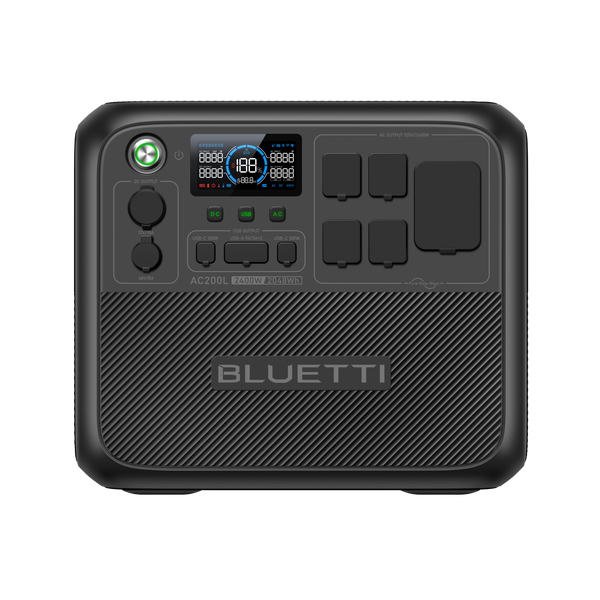
The AC200L holds 2,048 Wh and delivers 2,400 W of AC output. It accepts a wide solar voltage range, 12–145 V, which makes it flexible: it accepts panels that would be out of range for stations limited to 60 V. The 400 W panel uses only a third of the 1,200 W solar maximum, so this pairing is a starting point, more panel power can be added later, provided the combined Voc and Isc stay within the station’s limits.
For camping, that headroom is the point. On a longer stay, one 400 W panel may not refill 2,048 Wh in a single day of sun. This station lets you add a second panel later without replacing the station, but check the combined numbers first, and verify any new combination with the Solar Match tool before connecting it. Note also that this is a cross-brand pairing: brand does not matter; voltage, current, watts, and connector do.
Key numbers: station 2,048 Wh / 2,400 W AC; panel 400 W, Voc 48 V, Isc 11 A; station solar limits 12–145 V / 15 A / 1,200 W max.
BLUETTI Elite 300 + Renogy 400W Solar Blanket (G3)

The Elite 300 holds 3,014.4 Wh and delivers 2,400 W of AC output. It accepts up to 1,200 W of solar input at 12–60 V and up to 22 A, through an XT60 connector. The Renogy 400W Solar Blanket (G3) has a Voc of 39.2 V and an Isc of 13.1 A, both well inside the station’s limits, and its 400 W is a third of the 1,200 W maximum. The blanket uses an MC4 connector, so it connects to the Elite 300’s XT60 port with an MC4-to-XT60 adapter cable.
A solar blanket folds up for transport, which makes this pairing practical for travel despite the large station. The high 22 A current limit and 1,200 W solar maximum also leave room to add more panel power later, but check the combined numbers first: two of these blankets in parallel would reach 26.2 A, above the 22 A limit, so that combination would not work. See our guide on series vs parallel panels before connecting two panels together. This is the base-camp pick in this guide: the most capacity, the most room to grow, and the easiest panel to pack.
Key numbers: station 3,014.4 Wh / 2,400 W AC; panel 400 W, Voc 39.2 V, Isc 13.1 A; station solar limits 12–60 V / 22 A / 1,200 W max.
What to check before you buy
- Panel Voc against the station’s voltage range. The panel’s Voc must sit inside the station’s solar voltage range. Above the maximum risks damage; below the minimum means no charging. Our compatibility guide walks through this step by step.
- Panel Isc against the station’s current limit. The panel’s Isc must be at or below the station’s maximum solar current. Check the limit for your region, some stations differ between US and EU versions.
- Total panel watts against the station’s maximum solar input. Adding panels beyond the maximum does not charge the station faster. Read our guide on over-paneling to understand what happens when panel watts exceed the limit.
- Connector and adapter cables. Confirm the panel’s connector matches the station, or that a named adapter exists, for example, an MC4-to-XT60 or MC4-to-XT60i cable for EcoFlow stations, or a DC8020 cable for Jackery. A panel with the wrong connector and no available adapter cannot be used.
- Two panels: series or parallel. Connecting two panels changes the voltage and current the station sees. Series adds voltage; parallel adds current. Either can push the combination out of the station’s limits even when each panel alone is fine. See series vs parallel.
- Shade and panel angle at the campsite. Panels rarely reach their rated watts. Clouds, shade, angle, and heat all reduce output, and at a campsite, trees and tents shade panels more often than on a roof. Place the panel in full sun, angle it toward the sun, and move it during the day if you can. If charging seems slow, see our guide on why solar charging is slow and the solar charging optimisation guide before assuming something is broken.
- Weight and packed size. Check the station’s published weight and the panel’s folded size on the manufacturer’s page before you buy. A kit that is perfect on paper is the wrong kit if you cannot carry it to the site.
FAQ
What size solar generator do I need for camping?
Add up the watt-hours your devices use in a day and pick a station with at least that much capacity. Phones and lights need only a few hundred Wh; a portable fridge and a laptop for a weekend need roughly 1,500–2,000 Wh; a longer stay with more appliances needs 2,000 Wh or more. Then check that the panels can refill most of that in one day of sun.
Is a kit better than buying the station and panel separately?
A kit is simpler because the pairing is already checked. Buying separately can be cheaper or more flexible, but only if you verify the panel’s Voc, Isc, watts, and connector against the station’s limits first. Our Solar Match tool helps with that check.
Can I use a panel from a different brand than my station?
Yes, if the numbers match. The BLUETTI AC200L with an EcoFlow 400W panel in this guide is one example. Brand does not matter; voltage, current, watts, and connector do.
How long does it take a camping kit to recharge from solar?
It depends on the panel watts, the station’s capacity, and the weather. As a rough guide only, divide the station’s Wh by the panels’ real-world watts, panels typically deliver around 70–80% of their rated watts in good sun, and often less in poor conditions, to get an approximate number of sun hours. This is an estimate, not a guaranteed figure.
Can I add a second panel later?
Usually yes, if the station has a second solar port or the combined panels stay within its voltage, current, and watt limits. Check series vs parallel wiring first, and verify the combination with the compatibility checklist.
What happens if the panel’s Voc is higher than the station’s maximum?
Do not connect it. A Voc above the station’s maximum solar voltage can damage the charging circuit. Choose a panel with a lower Voc or a station with a higher voltage range.
Do I need an adapter cable?
It depends on the pairing. Some panels and stations share a connector (MC4 to MC4, for example). Others need a named adapter, such as MC4-to-XT60 or MC4-to-XT60i for EcoFlow stations or DC8020 for Jackery. Check the connector on both sides before ordering.
Can a solar generator run a camping fridge?
Yes, if the station has enough capacity and AC output for the fridge’s running watts and daily consumption. Check the fridge’s rated watts and daily Wh on its label or manual, and compare them with the station’s capacity and the panels’ daily output. A small 12 V camping fridge uses less than a full-size home fridge, but the exact number varies by model.
Which camping kit to pick
Pick by trip length, not by the biggest number. For one or two nights with phones, laptops and lights, the BLUETTI AC70 kit is enough, and at 10.2 kg it is the lightest station here. For a weekend with a small fridge, the EcoFlow DELTA 3 1500 kit adds 768 Wh and 800 W of output, and its single 400 W panel uses 80 percent of its solar maximum. For a family weekend, the Jackery Explorer 2000 v2 kit uses its full 400 W solar maximum with two panels and no adapter. For longer stays, choose between the BLUETTI AC200L, which leaves room to add panels and capacity later, and the BLUETTI Elite 300, which gives you 3,014.4 Wh now but no expansion. Before you buy any of them, check the published weight: the DELTA 3 1500 is about 16.5 kg, the Explorer 2000 v2 about 17.9 kg, the Elite 300 about 26.3 kg and the AC200L about 28 kg, so the carry is part of the decision.
Then check the refill rule. Divide the station’s Wh by the panels’ real-world watts, about 70 to 80 percent of rated watts in good sun. If the answer is more than the hours of sun you will get, the kit will run down over the trip. A 100 W panel on a 768 Wh station is a top-up setup, not a daily refill, while a 400 W panel on a 1,536 Wh station refills it in about five hours of good sun. Buy the panel for the refill you need, not the station alone.
Safety notes for camping
Check Voc, Isc and watts for every panel before you connect it, using the limits in each kit section above. A panel with a Voc above the station’s maximum can damage the charging circuit, and a panel below the minimum will not charge at all. Keep the station dry and its vents clear, and do not cover it while it charges. Use the station’s own sockets and never connect its AC output to household wiring or the grid. Add up the running watts before you switch things on, and remember that a fridge compressor draws a short surge when it starts. Pack the panel where it cannot be punctured or bent, and if any cable, panel or battery is damaged, swollen or unusually hot, stop using it and check the manual.
How we verify specs
All specifications in this guide were checked against manufacturer pages and manuals, and against the verified station and panel data in our Solar Match tool, on 2026-11-16 and 2026-11-17. The one exception is the SolarSaga 200W Isc figure of 11.2 A, which is tool-data-only, see the flag in the Explorer 2000 v2 section. The 5 pairings in this guide are the camping picks from our main kits guide, Best Solar Generator Kits 2026, where each pairing was verified the same way. We record the station’s capacity (Wh), AC output (W), maximum solar input (W), solar voltage range (V), maximum solar current (A), and connector, and the panel’s rated watts, Voc, Isc, and connector. A pairing is included only when the panel’s Voc falls inside the station’s voltage range, the panel’s Isc is at or below the station’s current limit, the total panel watts are at or below the station’s maximum solar input, and the connector matches or a named adapter cable is used. Where a specification was not published, for example, the connector of the BLUETTI SP100L, we say so and do not guess. Weights are not listed in this guide: the /product/ catalogue does not publish verified weights, and we do not publish a weight we have not verified against the current manufacturer datasheet.
Closing
A good camping kit is a matched pair that you can carry, set up, and recharge from the sun every day, not just the biggest station you can afford. Start with what you need to power and how much energy that takes in a day, then pick a station with enough capacity and AC output, and a panel (or two) that fits its voltage, current, and watt limits and that you can actually pack. The kits in this guide are a starting point, check any station and panel combination with our Solar Match tool and browse the full range in our product catalogue. For the full list of 9 verified kits, see Best Solar Generator Kits 2026. For more background, see the portable energy guide hub.