
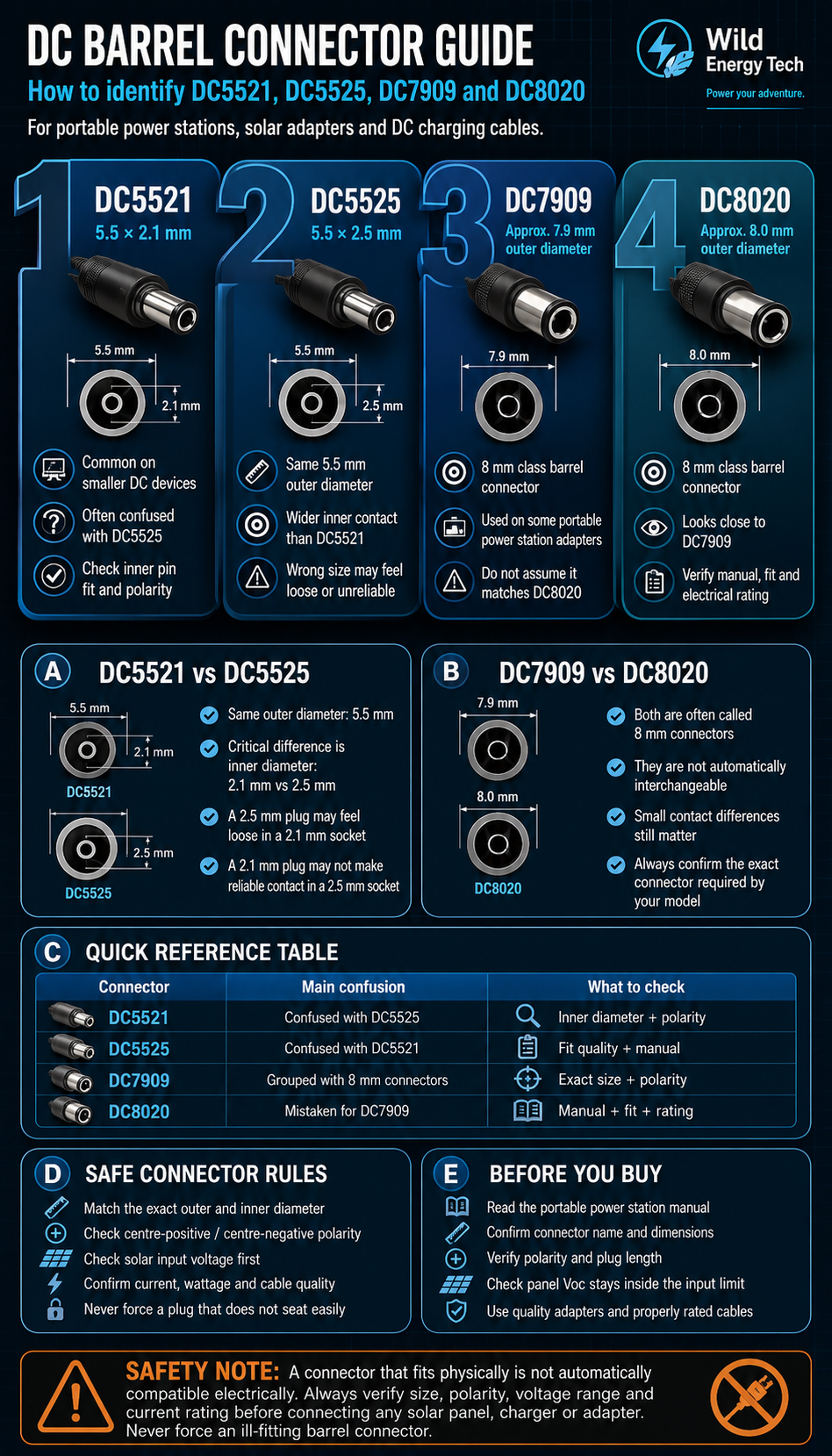
DC barrel connectors are common on portable power stations, solar adapters, small DC devices and older solar input systems. They may look simple, but small differences in diameter, centre pin size, polarity and input limits can decide whether a cable works safely or fails completely.
This guide explains the difference between DC5521, DC5525, DC7909 and DC8020 barrel connectors, why they are easy to confuse, and what portable power station users should check before buying or connecting a solar adapter.
The most important rule is simple: a barrel connector that fits physically is not automatically compatible electrically.
DC Barrel Connector Visual Carousel
Use this visual carousel to compare DC5521, DC5525, DC7909 and DC8020 barrel connectors, understand the most common size confusions, and check the safety steps before buying or connecting an adapter.
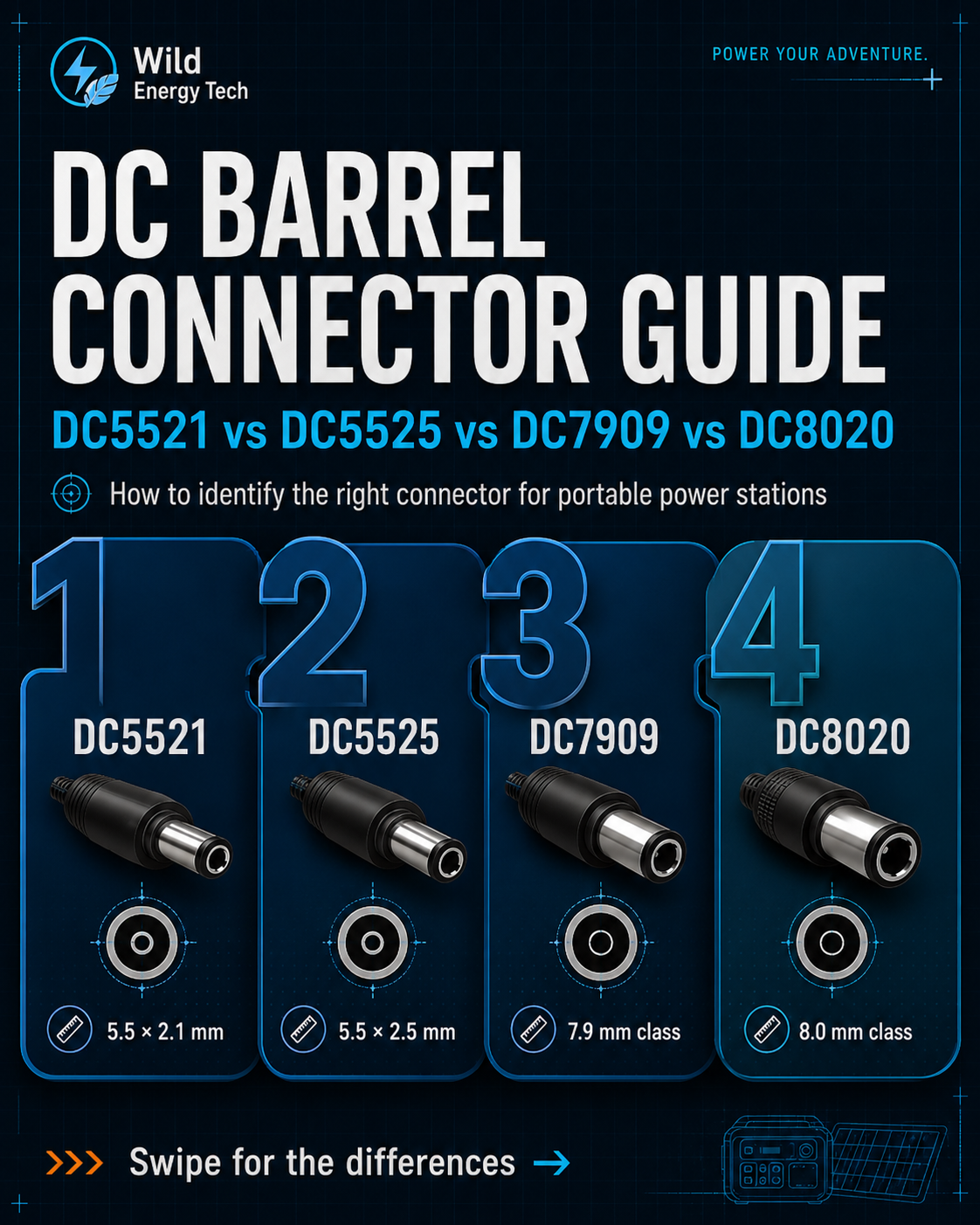
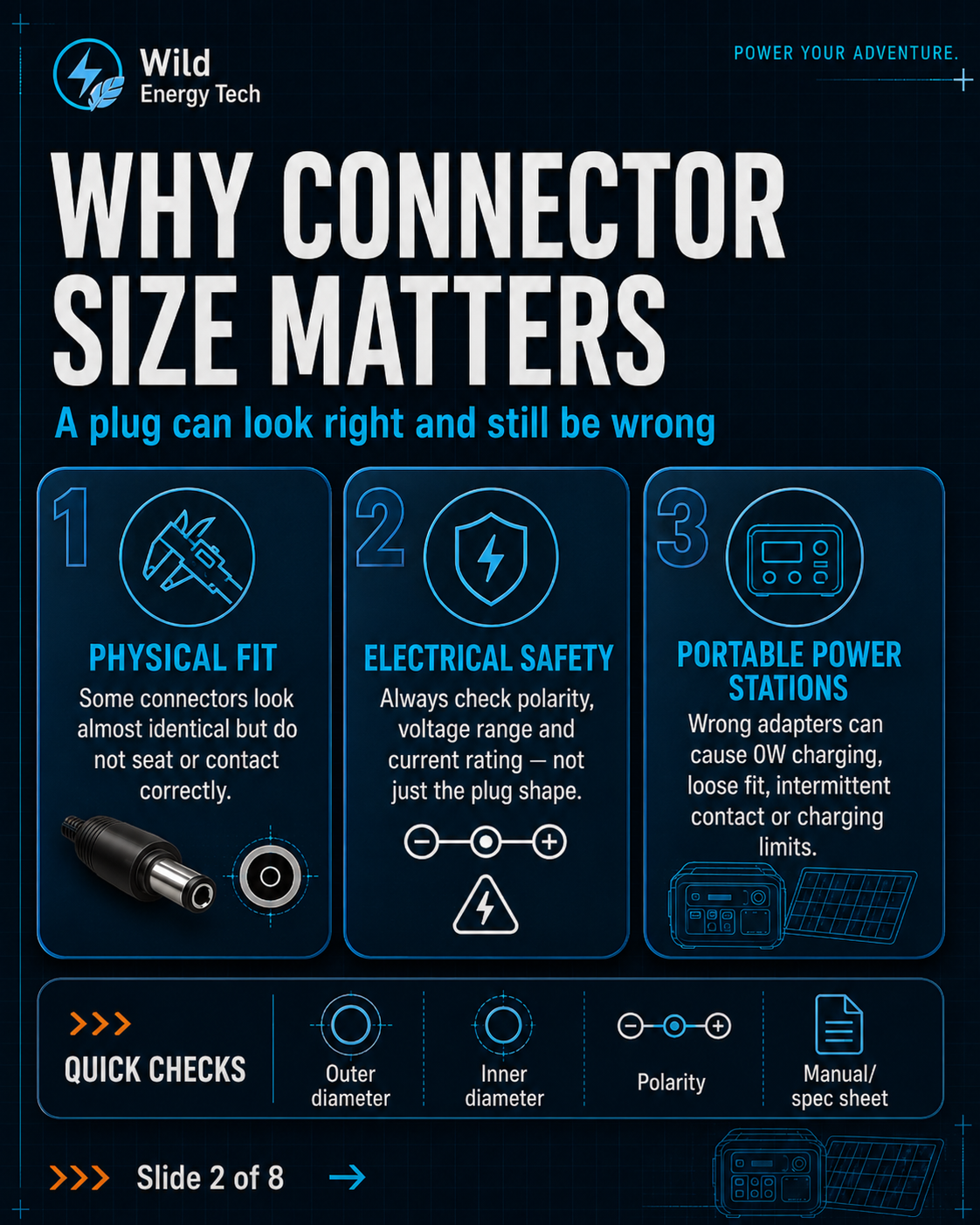
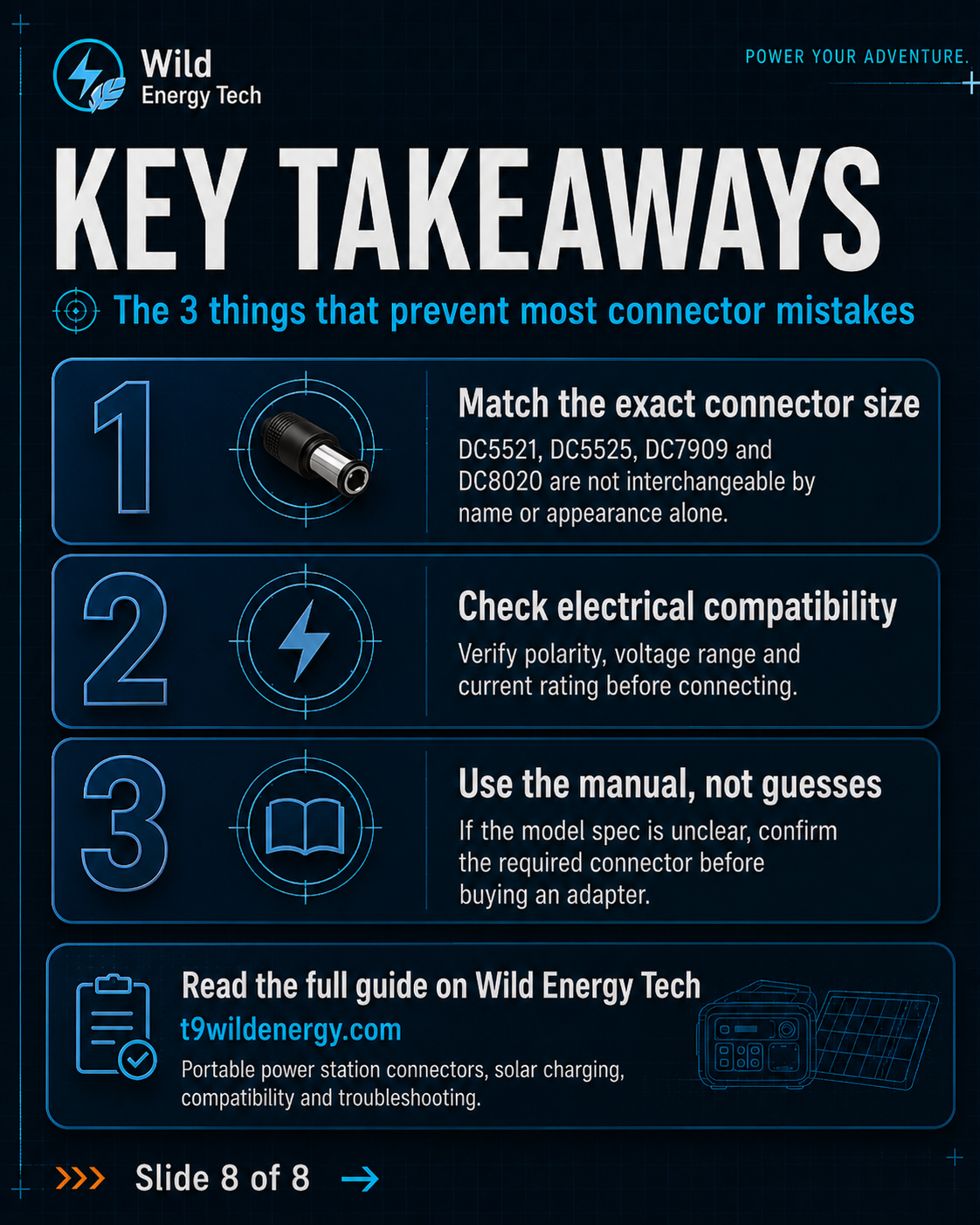
← Swipe or scroll to view all 8 slides →
Connector Display Case
DC5521 vs DC5525 vs DC7909 vs DC8020: What Changes?
DC barrel connectors can look very similar, but small size differences matter. A plug that almost fits is not necessarily safe or compatible. Always match the exact connector size, polarity, voltage, and current rating before connecting a solar panel, adapter, or charger to a portable power station.
Small Barrel
DC5521
- Often associated with 5.5 × 2.1 mm barrel plugs.
- Common on smaller DC devices and adapters.
- May look close to DC5525 but is not the same size.
- Check centre-pin fit and polarity before use.
Similar Shape
DC5525
- Often associated with 5.5 × 2.5 mm barrel plugs.
- Very close visually to DC5521.
- The larger inner diameter can change fit quality.
- A loose or forced fit can cause unreliable charging.
Larger Barrel
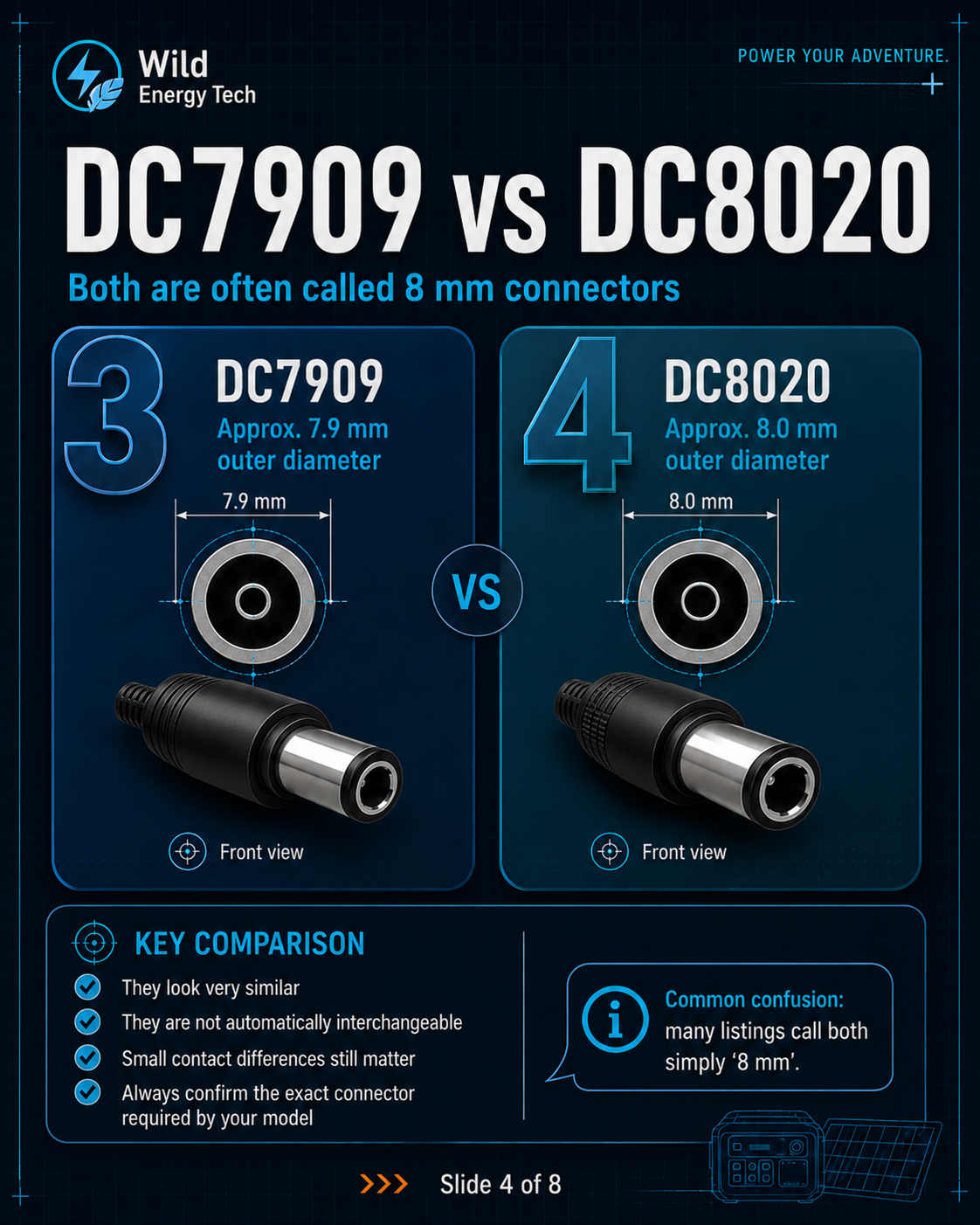
DC7909
- Typically around 7.9 mm outer diameter.
- Used by some portable power stations and solar adapters.
- Sometimes grouped loosely with “8 mm” connectors.
- Must not be confused with nearby barrel sizes.
8 mm Class
DC8020
- Typically around 8.0 mm outer diameter.
- Close to DC7909 but not automatically interchangeable.
- Fit, polarity, and current rating still matter.
- Always check the device manual before connecting.
Safe Connector Rule
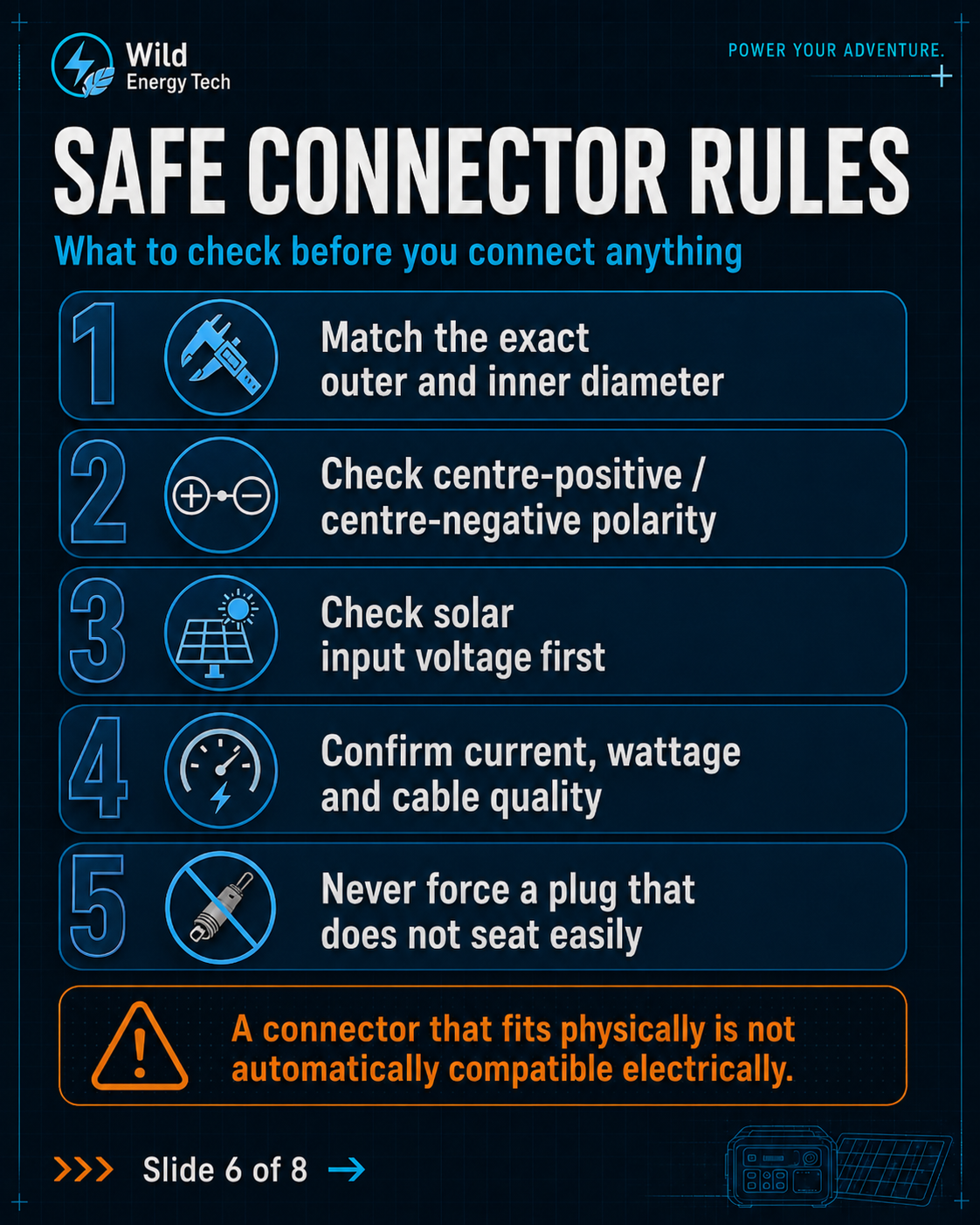
- Match the exact size: similar-looking barrel plugs can have different inner or outer diameters.
- Check polarity: centre-positive and centre-negative wiring are not interchangeable.
- Check ratings: voltage, current, cable quality, and connector fit all matter.
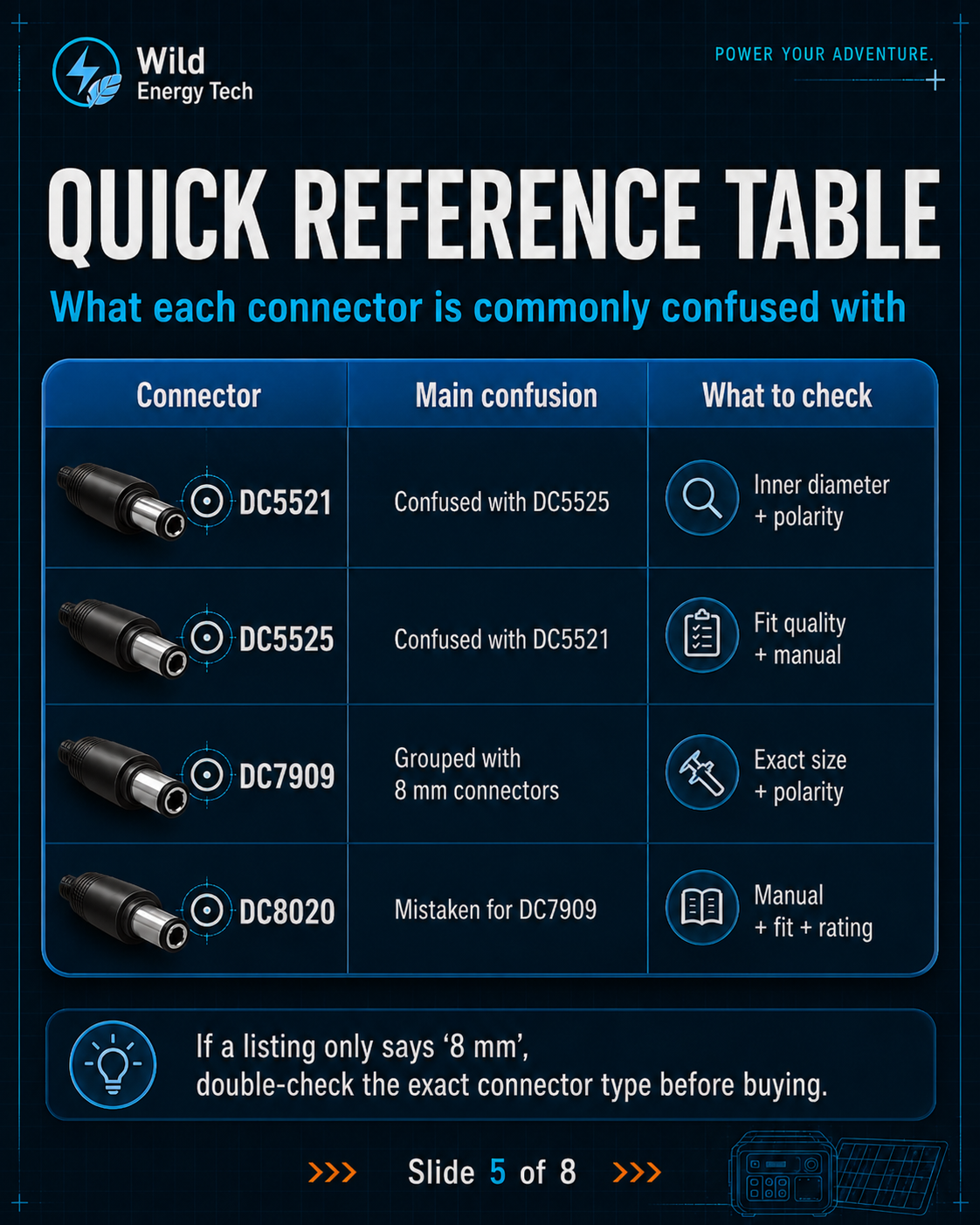
| Connector | Common size reference | Main confusion | What to check |
|---|---|---|---|
| DC5521 | 5.5 × 2.1 mm | Can be confused with DC5525 | Inner pin size and polarity |
| DC5525 | 5.5 × 2.5 mm | Looks close to DC5521 | Fit quality and device manual |
| DC7909 | Approx. 7.9 mm outer diameter | Often grouped with 8 mm connectors | Exact plug size and polarity |
| DC8020 | Approx. 8.0 mm outer diameter | May be mistaken for DC7909 | Manual, fit, and electrical rating |
What Is a DC Barrel Connector?
A DC barrel connector is a round power connector commonly used for low-voltage DC devices. It normally has an outer metal sleeve and an inner contact. One side carries positive and the other carries negative, depending on the device wiring.
In portable power station setups, DC barrel connectors may appear on solar input ports, charging adapters, DC output ports, small appliances, routers, LED lights, battery chargers and accessory cables.
The problem is that many barrel connectors look almost identical from the outside. A plug can appear to fit while still having the wrong inner diameter, centre pin size, polarity, current rating or voltage compatibility.
How DC Barrel Connector Names Work
Many DC barrel connector names describe their approximate physical size.
For example, DC5521 usually means a barrel connector with an outer diameter of about 5.5 mm and an inner diameter of about 2.1 mm. DC5525 usually means 5.5 mm outer diameter and 2.5 mm inner diameter.
Larger connector names, such as DC7909 and DC8020, are commonly used for barrel connectors with an outer diameter of approximately 7.9 mm and 8.0 mm, respectively. These are often seen in portable power station solar charging accessories, but they should not be treated as interchangeable without checking the exact model requirements. Never force a barrel connector that does not seat easily — forcing an ill-fitting plug can permanently damage the centre pin of the power station input port.
Common DC Barrel Connector Sizes
The table below gives a practical reference for the most common barrel connector names used around portable power stations and solar adapter cables.
| Connector name | Common size meaning | Common use | Main risk |
|---|---|---|---|
| DC5521 | 5.5 mm outer / 2.1 mm inner | Small DC devices, accessory ports, and some compact power setups | Can be confused with DC5525 |
| DC5525 | 5.5 mm outer / 2.5 mm inner | Power adapters, DC cables, some electronics and charging accessories | May feel loose or unreliable if used where DC5521 is expected |
| DC7909 | Often described as an 8 mm class barrel connector with a smaller centre pin | Some portable power station, solar input adapters and charging cables | Can be confused with DC8020 or brand-specific 8 mm connectors |
| DC8020 | Often described as an 8 mm class barrel connector with a larger centre pin | Some portable power station input ports and adapter systems | May not fit or may not connect correctly where DC7909 is expected |
Use this table as a starting point, not as a guarantee. Different brands may use similar names, slightly different tolerances, or proprietary connector variations.
DC Barrel Connector Dimensional & Mechanical Specifications
| Connector Designation | Nominal Barrel Dimensions | Polarity Requirement | Mechanical Fitment & Safety Rules |
|---|---|---|---|
| DC5521 |
5.5 mm Plug OD / ~2.1 mm Plug Center Hole Mates with ~2.1 mm Jack Center Pin |
Model-specific. Confirm conductor polarity with a multimeter against device documentation before powering. | Plug center hole (~2.1 mm) cannot correctly seat over a ~2.5 mm center pin jack. Never force a DC5521 plug into a DC5525 port. |
| DC5525 |
5.5 mm Plug OD / ~2.5 mm Plug Center Hole Mates with ~2.5 mm Jack Center Pin |
Model-specific. Verify polarity across contacts with a multimeter before connection. | A ~2.5 mm plug center hole may fit loosely over an ~2.1 mm jack center pin. Contact can be unreliable. Do not use this mismatch unless compatibility is explicitly confirmed by the device manufacturer. |
DC5521 vs DC5525: Why 2.1 mm and 2.5 mm Matter
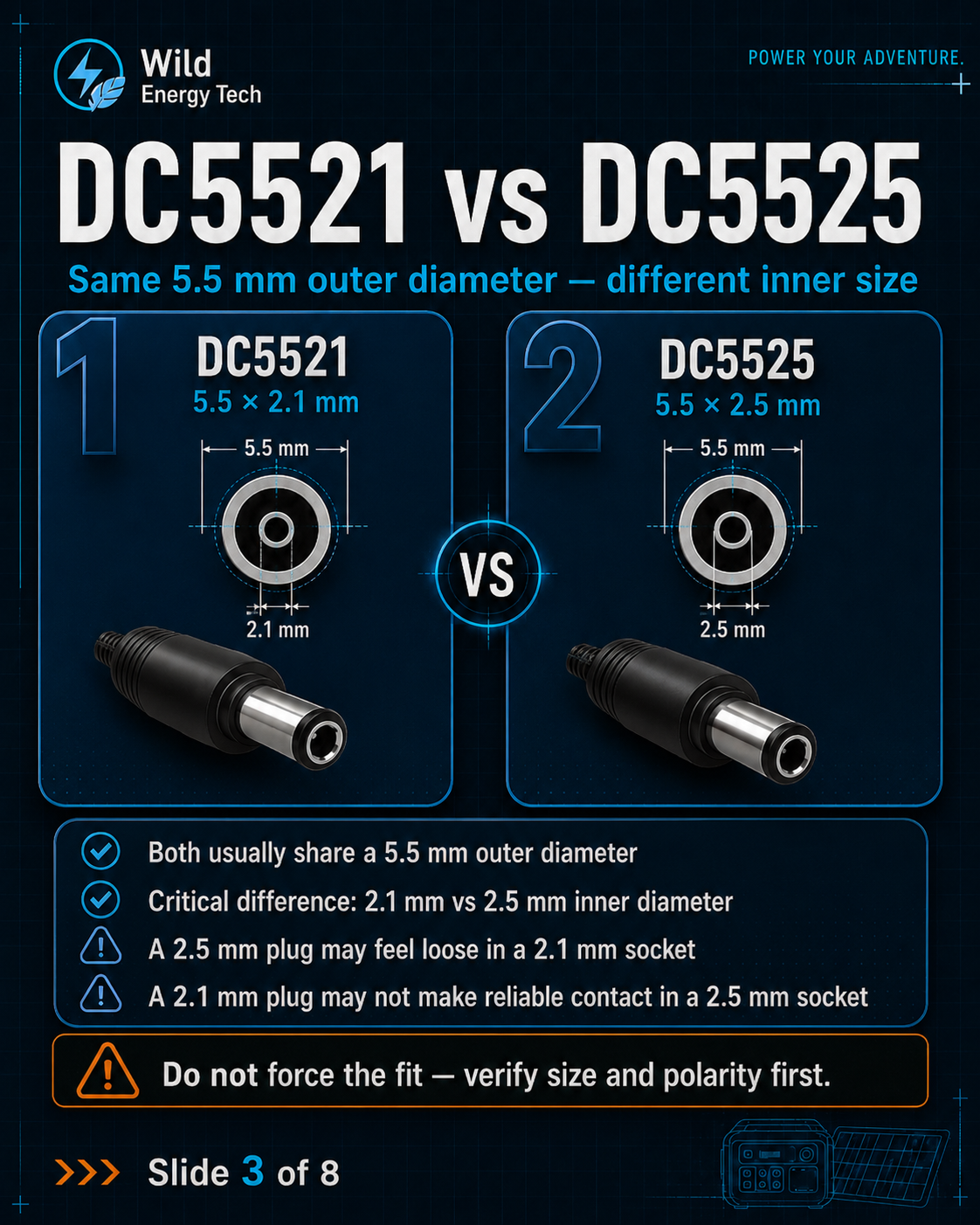
DC5521 and DC5525 are easy to confuse because both commonly use a 5.5 mm outer diameter. The difference is the inner diameter.
DC5521 usually refers to a 5.5 mm outer diameter and a 2.1 mm inner diameter. DC5525 usually refers to 5.5 mm outer diameter and 2.5 mm inner diameter.
That small difference can matter. If the centre pin contact is not correct, the cable may feel loose, disconnect easily, create unreliable charging, or fail to deliver power properly.
For portable power station users, the safest approach is to confirm the exact DC input or output connector size in the device manual before ordering a cable.
Size Identification Reference
DC5521 vs DC5525: The Inner Diameter Is the Difference
DC5521 and DC5525 share the same nominal 5.5 mm outer barrel diameter, which is why they can look almost identical. The critical difference is the centre-contact diameter: 2.1 mm for DC5521 and 2.5 mm for DC5525. They should not be treated as interchangeable.
- DC5521 plug into a DC5525 jack: the plug has a 2.1 mm centre hole, while the jack has a nominal 2.5 mm centre pin. The smaller hole cannot correctly pass over the larger pin, so it should not fit properly and must never be forced.
- DC5525 plug into a DC5521 jack: the plug has a 2.5 mm centre hole and can physically slide over the smaller 2.1 mm jack pin, but the contact can be loose and unreliable. This can cause intermittent power, voltage drop, resistance heating, or connector damage under load.
DC5521 — 5.5 × 2.1 mm
2.1 mm Centre Contact
- Outer diameter: 5.5 mm
- Centre-contact diameter: 2.1 mm
- Common on smaller DC devices, accessories, and some power-station outputs.
- A DC5525 plug may enter a DC5521 jack but can make loose, unreliable contact.
DC5525 — 5.5 × 2.5 mm
2.5 mm Centre Contact
- Outer diameter: 5.5 mm
- Centre-contact diameter: 2.5 mm
- Common on power adapters and some DC charging accessories.
- A DC5521 plug should not fit correctly over the larger centre pin of a DC5525 jack.
| Connection | Nominal dimensions | Result | Recommendation |
|---|---|---|---|
| DC5521 plug → DC5525 jack | 2.1 mm plug hole → 2.5 mm jack pin | Does not fit correctly | Do not force the connector |
| DC5525 plug → DC5521 jack | 2.5 mm plug hole → 2.1 mm jack pin | May fit physically but can be loose | Do not use unless the device manufacturer explicitly specifies compatibility |
What Is a DC5521 Port Used For on Portable Power Stations?
On specific portable power stations, DC5521 ports are used as regulated 12V DC auxiliary outputs. For example, EcoFlow documentation for the DELTA 2, DELTA Max, and RIVER 2 Max lists DC5521 outputs at approximately 12.6 V / 3 A per port. These outputs can power compatible low-voltage accessories such as 12V routers and LED lighting. Other products may use DC5521 differently, so always verify the port label, voltage, current, polarity, and whether the port is an input or output in the manual for the exact model.
DC7909 vs DC8020: Why 8 mm Connectors Are Confusing
DC7909 and DC8020 are especially confusing because both are often discussed as 8 mm class connectors. Some users and sellers describe them casually as “8 mm solar connectors”, but that is not precise enough.
The centre pin and internal contact size can be different. That means a DC7909 cable and a DC8020 cable may look similar, but they are not automatically interchangeable.
This is why some brands sell specific DC7909 to DC8020 or DC8020 to DC7909 adapters. The existence of these adapters is a useful reminder that the connector family is not universal.
If your power station manual says DC7909, do not assume that a random DC8020 cable is correct. If it says DC8020, do not assume that any 8 mm adapter will work safely.
What Makes a DC Barrel Connector Compatible?
Connector compatibility is not only about the plug shape. A safe setup depends on several details working together.
- Outer diameter: the outside size of the barrel plug must match the port.
- Inner diameter: the inner contact must match the centre pin correctly.
- Plug length: the plug must reach the contact point properly.
- Polarity: centre-positive and centre-negative wiring are not interchangeable.
- Voltage: the solar panel or charger must stay inside the power station’s allowed input voltage range.
- Current: the cable and connector must be suitable for the expected current.
- Wattage: the setup must respect the power station’s solar input behaviour and limits.
If any of these details are wrong, the setup may fail even if the connector appears to fit.
Polarity: Centre Positive vs Centre Negative
Polarity is one of the most important checks with DC barrel connectors. Many DC barrel systems are centre-positive, but you should never assume this without checking.
If the polarity is reversed, the device may not work, may show an error, or may be damaged, depending on its protection circuitry.
Before connecting a third-party cable or adapter, check the polarity symbol on the device, the power station manual, the solar panel label and the adapter specification.
A digital multimeter can help confirm polarity before connecting equipment.
Related guide: How to Check Solar Panel Polarity Before Connecting to a Portable Power Station
Do Not Ignore Solar Input Limits
A correct barrel connector does not mean the solar panel is compatible. The electrical limits matter more than the plug shape.
Before using a DC barrel solar adapter, check the power station’s solar input voltage range, maximum input current and maximum solar input wattage.
The most dangerous mistake is exceeding the maximum input voltage. A panel or series-connected panel setup with too much open-circuit voltage can damage the power station.
Current and wattage limits also matter, but voltage should be checked first because over-voltage is one of the most serious compatibility risks.
Common Mistakes With DC Barrel Connectors
These are the mistakes portable power station users should avoid.
Buying by appearance only
Many barrel connectors look similar. Do not buy an adapter only because the picture looks close to your port.
Assuming all 8 mm connectors are the same
DC7909 and DC8020 are not automatically interchangeable. Always check the exact connector requirement for your model.
Ignoring polarity
A barrel plug can fit while the polarity is wrong. Check centre-positive or centre-negative wiring before connecting.
Using thin or low-quality adapters
Cheap adapters may use thin wire, poor contacts or weak insulation. This can cause voltage drop, heat or unreliable charging.
Forgetting the solar panel voltage
The connector may be correct, but the solar panel voltage may still be outside the accepted range of the power station.
DC Barrel Adapter Buying Checklist
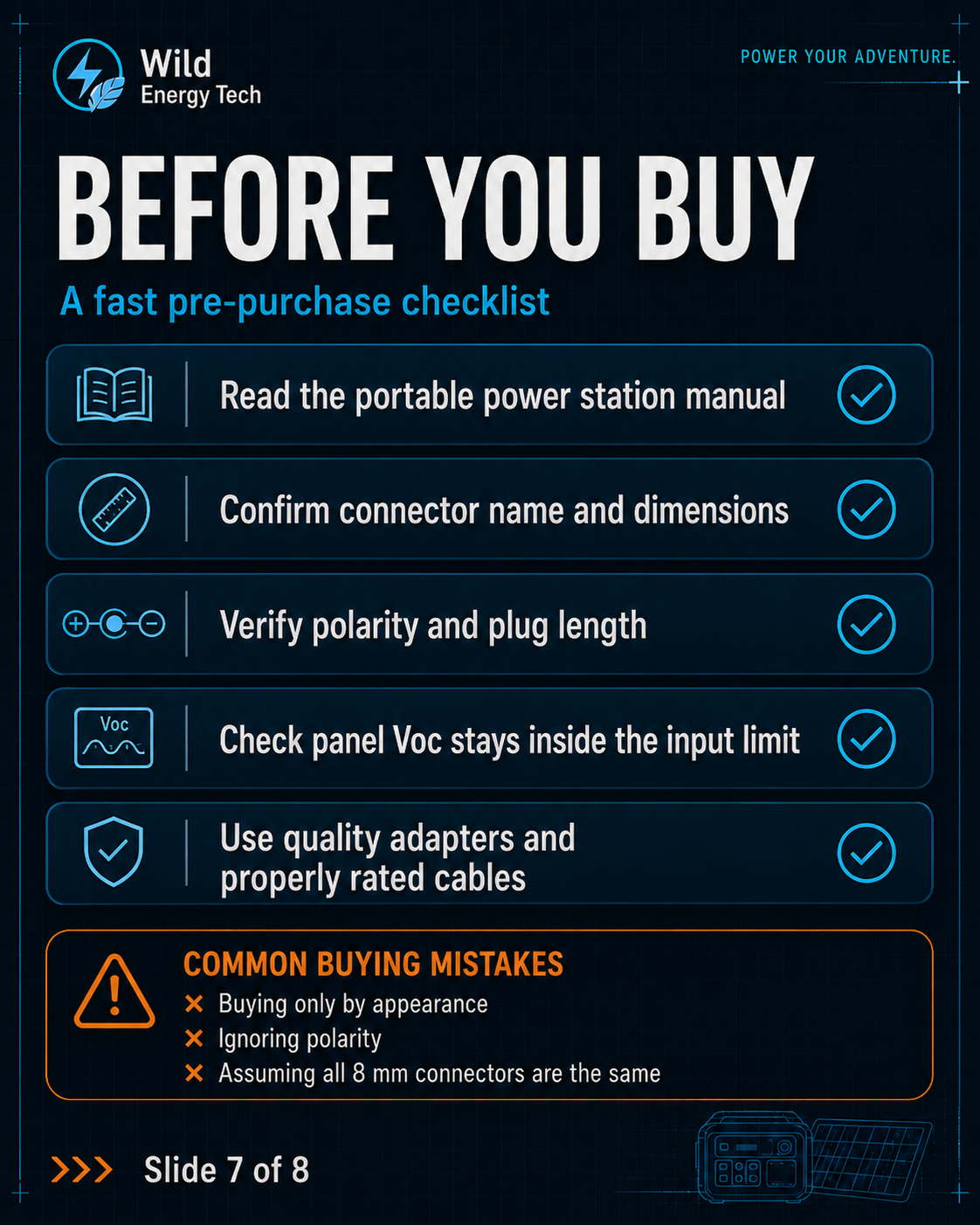
Before buying a DC barrel adapter for a portable power station, check these points:
- What exact connector does the power station manual specify?
- Is it DC5521, DC5525, DC7909, DC8020 or a brand-specific connector?
- Does the adapter match the correct outer and inner diameter?
- Does the plug length match the input port properly?
- Is the polarity correct?
- Is the solar panel open-circuit voltage within the allowed input range?
- Is the adapter rated for the expected current?
- Is the cable thick enough for the charging current and cable length?
- Is the adapter from a trustworthy seller with clear specifications?
- Have you checked the power station manual before connecting?
DC Barrel vs MC4, XT60 and XT60i
DC barrel connectors are only one part of the portable power station connector landscape.
Many solar panels use MC4 connectors on the panel side. Some power stations use XT60 or XT60i inputs. Other models use DC barrel connectors such as DC7909 or DC8020. This is why solar adapter cables often convert from MC4 to another connector type.
If you are not sure which connector you are looking at, start with the visual guide below.
Related guide: Portable Power Station Visual Connector Guide
Related guide: MC4 to XT60i vs XT60 Cable Guide
Frequently Asked Questions: DC Barrel Fitment & Compatibility
Can you plug a DC5521 connector into a DC5525 jack?
No. A DC5521 plug has an ~2.1 mm center hole, whereas a DC5525 jack contains an ~2.5 mm center pin. The smaller opening cannot correctly seat over the larger pin. Never force this connection.
What happens if you plug a DC5525 plug into a DC5521 jack?
A DC5525 plug with an ~2.5 mm center hole may physically fit over a DC5521 jack’s ~2.1 mm center pin because both use a nominal 5.5 mm outer barrel. However, the center contact can be loose or unreliable, causing intermittent power or poor electrical contact. Do not use this combination unless explicitly confirmed by the device manufacturer.
Final Recommendation
DC barrel connectors are useful, but they are also easy to misidentify. DC5521, DC5525, DC7909 and DC8020 may look simple, but small size differences can affect fit, contact quality and charging reliability.
Before connecting a solar panel or adapter to a portable power station, check the exact connector size, polarity, voltage range, current limit and cable quality.
The safest adapter is not the one that almost fits. The safest adapter is the one that matches the full specification of your power station and solar setup.
Related Wild Energy Tech Guides
If you are checking solar adapters, connector types or portable power station compatibility, these guides may also help:
Portable Power Station Visual Connector Guide
Portable Power Station Hardware Vault
How to Check Solar Panel Polarity Before Connecting to a Portable Power Station
MC4 to XT60i vs XT60 Cable Guide
Portable Power Station Hardware Guide
Portable Power Station Not Detecting Solar Panel: What to Check First