
Publication history: Originally published 17 May 2026. Substantially reviewed and updated 23 August 2026.
Module role: explain the two voltage figures that control different parts of a compatibility decision. Use the full T9 Compatibility Method when deciding whether to connect an entire system.
This page is documentation-based technical analysis. It does not report physical testing.
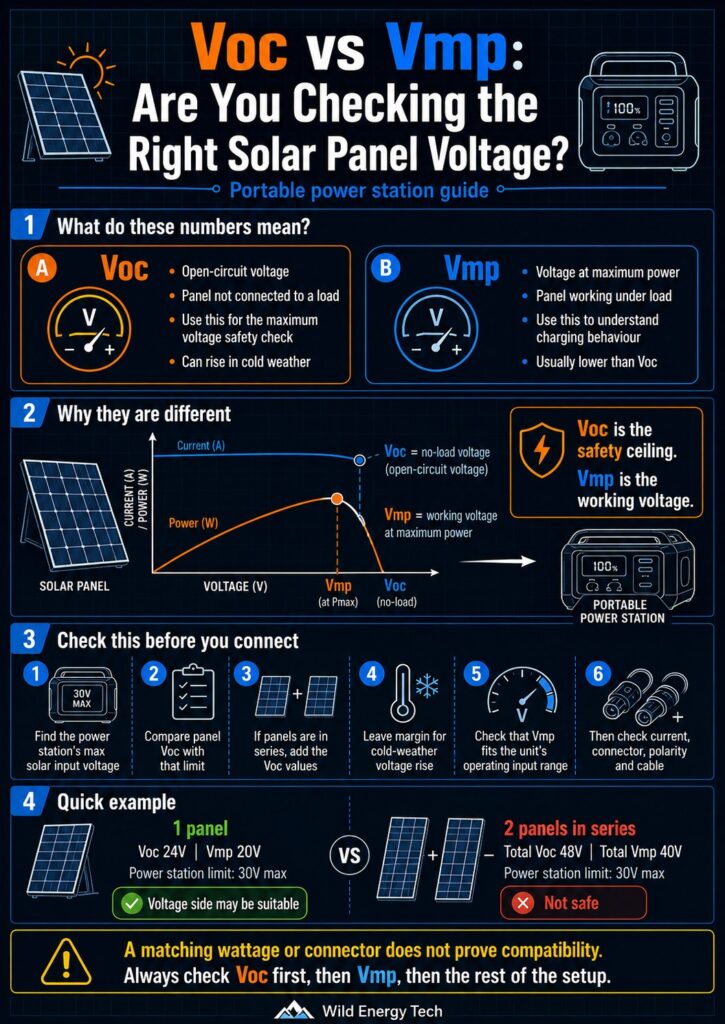
Voc and Vmp Are Different Questions
| Figure | Electrical state | Decision it supports |
|---|---|---|
| Voc | Open circuit; panel is not delivering load current | Can maximum array voltage exceed the controller’s absolute limit? |
| Vmp | Panel operating near its maximum-power point | Is operating voltage likely to sit inside the controller’s documented MPPT/run range? |
Voc is normally higher than Vmp. Comparing only Vmp with a maximum-voltage limit can therefore miss the highest voltage the controller may see.
How to Read a Panel Datasheet
Use the exact module label or manufacturer datasheet. Record Voc, Vmp, Isc, Imp, rated power, the Voc temperature coefficient and the Standard Test Condition reference. Do not use the marketed nominal-voltage class.
The EcoFlow NextGen 220 W panel manual provides a complete example: Voc 21.5 V, Vmp 18.4 V, Isc 12.4 A, Imp 11.9 A, rated power 220 W and a Voc temperature coefficient of −(0.25±0.03)%/°C.
Voc Controls the Maximum-Voltage Gate
For one panel, compare cold-adjusted Voc with the station’s absolute maximum input voltage. For matched panels in series:
Vocarray,STC = Vocpanel × number in series
Parallel strings do not multiply string voltage; each string retains the voltage created by its series count. The maximum-voltage check still uses the Voc of a complete string, not one panel.
The Victron MPPT installation manual states that maximum array Voc must stay below the charger’s maximum and specifically instructs users to include the panel’s temperature coefficient when calculating series count.
Cold-Temperature Voc Calculation
If the panel publishes βVoc as a decimal per °C:
Voc(T) = VocSTC × [1 + βVoc × (T − 25°C)]
For N matched panels in series:
Vocstring(T) = N × VocSTC × [1 + βVoc × (T − 25°C)]
The coefficient must come from the actual panel. Do not substitute a universal value. Temperature-coefficient tolerances should be considered when a design is close to a hard ceiling.
Reproducible calculation: EcoFlow 220 W panel at −10°C
Using Voc 21.5 V and the nominal βVoc of −0.25%/°C:
- Convert coefficient: −0.25% = −0.0025.
- Temperature difference: −10 − 25 = −35°C.
- Adjustment factor: 1 + (−0.0025 × −35) = 1.0875.
- Cold Voc: 21.5 × 1.0875 = 23.38 V.
Two in series produce an estimated 46.76 V. Three produce 70.14 V under the same nominal assumption. The documented tolerance is ±0.03%/°C, so the conservative cold-voltage end is −0.28%/°C. At −10°C it gives 23.61 V for one panel, 47.21 V for two and 70.82 V for three. The more-negative end controls because it produces the larger cold Voc. Use it where a hard ceiling is close; these examples’ conclusions do not change. The calculation is T9-derived from EcoFlow’s published figures, not a measured result.
Vmp Controls the Operating-Range Check
Vmp describes voltage around the maximum-power operating point under the stated test conditions. A controller needs suitable operating voltage to start and track effectively. The required range is model-specific.
The EcoFlow DELTA 2 manual lists solar input at 11–60 V. Other manufacturers describe input windows differently. Victron, for example, documents controller-specific startup relationships to battery voltage. Do not transfer one controller’s minimum/run rule to another product.
For matched panels in series:
Vmpstring ≈ Vmppanel × number in series
For matched strings in parallel, Vmp remains approximately the string value while current increases.
Why Voc and Vmp Move With Temperature
PV voltage generally increases as cell temperature falls and decreases as cell temperature rises. The exact response is panel-specific. The panel’s published coefficients—not a generic internet estimate—must control the calculation. PVEducation’s temperature reference explains the underlying photovoltaic relationship; the manufacturer datasheet supplies the coefficient used for a product decision.
Voltage Decision Reference
| Observation | Interpretation | Action |
|---|---|---|
| Cold array Voc exceeds absolute maximum | Hard limit failure | Do not connect |
| STC Voc fits but cold Voc is unknown | Safety evidence incomplete | Obtain βVoc and minimum-temperature evidence |
| Cold Voc fits but Vmp is below documented run range | Maximum voltage passes; operation may fail | Change configuration only within all other limits |
| Voc and Vmp fit | Voltage gates pass | Continue to current, power, connector and polarity gates |
Frequently Asked Questions: Voc vs. Vmp Compatibility
Which voltage should I use to check solar compatibility: Voc or Vmp?
You must evaluate both parameters against distinct hardware requirements. Use Voc (Open-Circuit Voltage) as your mandatory safety ceiling: calculate the array’s maximum expected cold-weather Voc using the panel’s temperature coefficient (βVoc) and minimum local temperature, confirming it never exceeds the power station’s maximum DC input voltage limit. Once safety is verified, use Vmp (Voltage at Maximum Power) as your operating performance check to confirm working voltage falls within the station’s MPPT tracking range.
Why is Voc always higher than Vmp on a solar panel specification sheet?
Voc represents the maximum electrical potential across panel terminals when no current is flowing (0 Amps). Vmp is the operating voltage at the maximum power point under the applicable test or operating conditions; real-world output may differ from the panel’s nameplate rating once an active load is connected and current flows.
What This Page Does Not Decide
Passing Voc and Vmp checks does not establish full compatibility. Current, short-circuit current, array wattage, manufacturer over-paneling rules, connector, pinout, cable rating and polarity remain separate gates. Use the canonical Compatibility Method for the final classification.
Evidence
- EcoFlow NextGen 220 W Panel Manual — Voc, Vmp, current, power and temperature coefficients.
- EcoFlow DELTA 2 User Manual — station solar-input figures.
- Victron MPPT installation guidance — maximum Voc and temperature-coefficient requirements.
- PVEducation: effect of temperature — engineering background.