
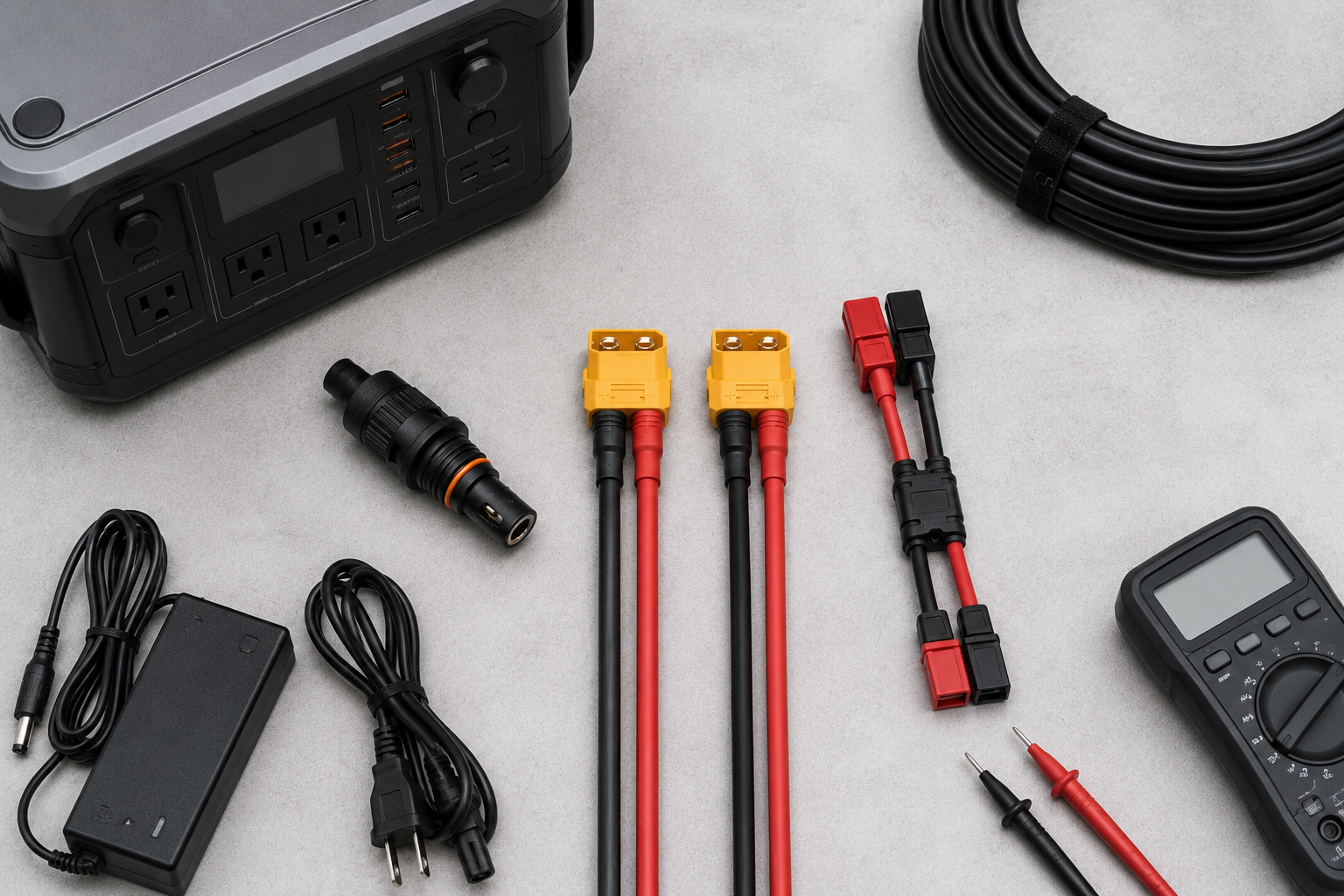
This portable power station hardware guide explains how cables, connectors, polarity, cable gauge, and solar adapters affect safety, compatibility, and charging performance.
The quality of any portable energy system is fundamentally limited by the components that connect the solar array to the power station. In off-grid setups, solar adapters are not just accessories. They are the bridge between photovoltaic generation and the battery management system.
Using poor-quality connectors, thin-gauge wiring, or incorrectly wired adapters can reduce charging efficiency, create unnecessary heat, and increase the risk of damaging a portable power station’s DC input system.
For a broader overview of adapters, connectors, testing tools, and compatibility topics, visit the Hardware Vault.
The Technical Standard for Solar Adapters in Portable Power Stations
When selecting solar adapters, the most important technical factor is the relationship between current, resistance, cable length, and connector quality. For systems above 100W, cable gauge becomes especially important.
A 12AWG cable may be suitable for shorter runs, but longer cable distances can increase voltage drop and reduce the wattage that actually reaches the power station. For higher-current solar setups, 10AWG copper wiring is often the better choice because it reduces resistance, limits heat buildup, and helps the MPPT controller receive a more stable input.
For a wider explanation of charging efficiency, panel placement, and input behaviour, read the Solar Charging Optimisation Guide.
Connector Integrity: MC4, XT60i, and DC Inputs
MC4 connectors remain among the most common standards for portable and rigid solar panels because they provide secure, weather-resistant connections. However, many failures occur at the adapter point, where MC4 cables connect to a power station’s proprietary input.
For EcoFlow users, the XT60i connector is especially important. Unlike a standard XT60 connector, the XT60i version includes a signalling pin that helps the power station identify the connection as a solar input instead of a car charging source. Without this signal, some EcoFlow models may limit charging current to around 8A.
For a full troubleshooting walkthrough, read our EcoFlow solar charging stuck at 8A guide.
For Jackery users, compatibility depends on the model and input type. Some units use DC7909, DC8020, or 8mm-style inputs, while others may require specific adapter types. Before connecting third-party solar panels, the voltage range, connector size, polarity, and current rating should always be checked.
Polarity Standards: EcoFlow vs. Jackery
Polarity management is a critical safety step when working with solar adapters. Most modern adapters follow a standard centre-positive configuration, but some older power stations, third-party panels, or adapter kits may not follow the same layout.
Before making the first connection, it is good practice to verify polarity with a multimeter. A reversed polarity connection can prevent charging, trigger protection systems, or, in worse cases, damage the DC input board of the power station.
Cable Gauge and Thermal Efficiency
Not all solar adapters are built for the same current load. A thin cable used with a high-wattage solar array can create resistance, heat, and voltage loss. This can cause the power station to receive less power than expected, even when the solar panels are performing correctly.
For small portable panels, 12AWG may be enough. For larger solar arrays, longer cable runs, or higher-current setups, 10AWG wiring is usually a safer and more efficient option. The goal is to deliver stable voltage and current to the MPPT controller without unnecessary loss.
Environmental Resistance and Build Quality
Solar adapters are often used outdoors, exposed to sunlight, dust, moisture, and repeated movement. Good adapters should use durable insulation, secure connector housings, and well-moulded terminals to reduce the risk of arcing, corrosion, or loose contact.
For outdoor use, weather-resistant connectors and UV-resistant cable insulation are important. Materials such as XLPE insulation are often preferred because they handle heat and sunlight better than basic cable jackets.
Wild Energy Tech Hardware Vault Standard
The Wild Energy Tech Hardware Vault focuses on components that meet practical off-grid energy requirements: correct pinout, reliable polarity, adequate cable gauge, durable insulation, and compatibility with popular portable power station brands such as EcoFlow, Jackery, and Bluetti.